


by WorldTribune Staff, November 20, 2026 — Real World News
A sign of the times in Northeast Asia was the receptions received by the leaders of South Korea and Japan at the Asia-Pacific Economic Cooperation (APEC) summit.
The grand welcomes China bestowed on U.S. President Donald Trump and South Korean President Lee Jae-Myung were not extended to Japanese Prime Minister Sanae Takaichi.
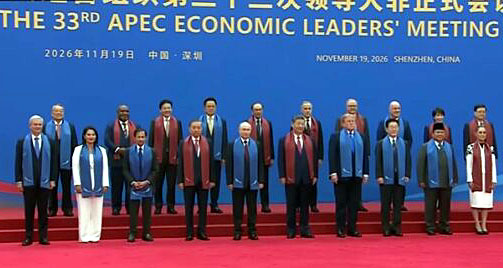
APEC: While South Korean President Lee Jae-Myung was placed in the front row next to President Donald Trump and Xi Jin ping, Japanese Prime Minister Sanae Takaichi was near the end of the back row. / Video Image
South Korean has long been part of the group of Northeast Asian nations including Japan and Taiwan that have aligned with the United States to counter China’s ambitions to control the entire Pacific region. Seoul’s drift toward Beijing during its last two leftist presidents have been noticed in Washington, DC.
Xi defined South Korea-China relations as “close and friendly neighbors and strategic cooperative partners.”
Communist China came to the assistance of North Korea against South Korean and U.S./UN forces in the Korean War.
At her post-summit news conference Thursday, Takaichi was resolute: “We pursued vigorous diplomacy aimed at maintaining and strengthening a free and open international order based on the rule of law, and came away with a clear sense of progress.”
Takaichi also touted a major headache for the Chinese Communist Party — the Quad summit earlier in the week, where heads of Japan, the U.S., Australia and India opposed attempts to change the status quo by force or coercion and expressed concerns over arbitrary export restrictions.
At a press conference on Nov. 20, Trump emphasized the importance of the Quad event noting agreements on the “new Quad SI accelerator” and agreements on Quad cooperation in “maritime security”.
Related: Xi and strategy to control First Island Chain, faces devastating loss of face to … a woman, July 2, 2026
After meeting with Xi on Nov. 18, Lee stated: “Above all, peace and stability on the Korean Peninsula must be the foundation for the mature development of the strategic cooperative partnership between South Korea and China.”
It was the third bilateral meeting between South Korea’s leftist president and Xi, following those held in Gyeongju last November and in January of this year.
Takaichi landed in Shenzhen on Wednesday and was met on the tarmac by retired diplomat and protocol official Zhang Qiyue. There were no flower-bearing performers or festive music as seen for Trump, Lee, and other leaders.
Organizers placed Takaichi far from Chinese Communist Party leader Xi Jinping at the welcome banquet and positioned her near the edge of the back row in the leaders’ group photo, while Xi stood near Trump and Russian leader Vladimir Putin.
Takaichi exchanged brief handshakes with Xi and attempted to speak with him, though no formal bilateral meeting was held between the two leaders.
Relations deteriorated sharply after Takaichi suggested in November 2025 that a crisis or Chinese military action involving Taiwan could threaten Japan’s survival and potentially prompt a Japanese military response.
The communist regime in Beijing demanded a retraction and responded with economic measures, including restrictions on rare earth and dual-use exports, limits on Japanese seafood imports, and warnings against travel to Japan.
Analysts say Beijing used the APEC summit staging to project power while signaling displeasure with Tokyo, as reported by The Japan Times.
“China is a country that pays extremely close attention to diplomatic protocol, so it’s hard to see these choices as anything other than a deliberate political message,” the Japan Times cited Nobukatsu Kanehara, a former deputy chief of Japan’s National Security Secretariat, as saying.
While the ceremonial snubs were noted, the most consequential omission was Xi’s refusal of bilateral talks with Takaichi, analysts said.
“The contrast with the 2014 APEC in Beijing was particularly telling. Xi had greeted then-Prime Minister Shinzo Abe with a notoriously frosty expression amid strained ties over territorial and historical disputes, despite a hard-won agreement days earlier to manage their differences. But after the awkward handshake came a substantive bilateral meeting,” the Japan Times noted.
Kanehara, who also served as a senior adviser to Abe, attributed the recent inhospitality partly to the shifting balance of power between the two nations.
While Abe commanded considerable diplomatic influence through his rock-solid ties with Washington, Moscow and European capitals, China’s economy has since grown to more than four times that of Japan in nominal terms.
“China no longer sees Japan as a great power the way it once did,” Kanehara said, adding that officials in Beijing are “seeking to teach a lesson” that the Taiwan issue remains at the heart of China’s off-limits core interests.
The Japan Times noted that Takaichi spoke with Trump by phone, “during which the two reaffirmed their commitment to taking the U.S.-Japan alliance — which they described as a relationship between their countries’ most trusted allies — to even greater heights. China was conspicuously absent from her account of this week’s diplomatic achievements.”
