


Special to WorldTribune.com
 By John J. Metzler, June 17, 2026
The lavish welcome China’s Leader Xi Jinping received on his recent visit to North Korea stylistically underscored a deep and comradely relationship between the two communist regimes.
Xi’s trip to Pyongyang, his first in seven years to the secluded socialist state, was nonetheless more about reviving and rebalancing ties with the dictator Kim Jong-Un than about political substance.
Xi as General Secretary of the Chinese Communist Party, lavished praise on North Korea, a neighboring state sharing many of China’s cultural traditions.
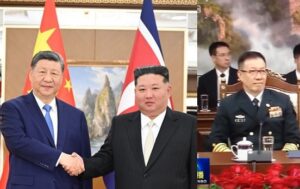
On June 8, 2026 CCP leader Xi Jinping arrived in Pyongyang, for a summit with North Korea’s Kim Jong-Un. Accompanying Xi was Defense Minister Dong Jun. / People’s Daily and CCTV
State media reported both are “socialist countries led by communist parties with traditional friendship, rooted in their shared ideals and beliefs as well as their common goals, and backed by a profound historical foundation, a solid political basis, and strong emotional bonds.”
During the Korean war for example, newly founded People’s Republic of China sent hundreds of thousands of “volunteers” to aid North Korea’s attack on South Korea. The Chinese communist forces sustained huge losses in helping their North Korean comrades, a memory still part of a near-sacred political mantra of relations between both states.
China’s former leader Chairman Mao described the PRC/DPRK relationship as “close as lips and teeth.”
Beijing signed the 1961 “Treaty of Friendship, Cooperation and Mutual Assistance” with North Korea, curiously China’s only current mutual defense agreement with a foreign country.
Moscow later inked a mutual defense treaty with Pyongyang in June 2024.
The quaintly titled Democratic Republic of Korea (DPRK) aka North Korea remains an isolated and sanctions-constrained state, bound by the consequences of its own rash and illegal nuclear weapons/missile programs. Though China has been decidedly nervous about North Korean nukes and has previously called for denuclearization, the trip did not openly touch on the sensitive issue.
The visit was about energizing the old time Communist proletarian revival between Beijing and Pyongyang.
Related: Xi meets Kim, urges ‘practical cooperation’ in nod to North’s strategic weapons buildup, June 9, 2026
During the visit North Korea’s Kim Jong-Un commented, “DPRK-China relationship is unbreakable.” It’s not known if Kim’s powerful sister Kim Yo-Jong or his daughter Ju-Ae, heir apparent, met with China’s Xi.
Nonetheless in recent years the Pyongyang regime has tilted to Moscow in a bid to revive its long-standing ties with the former Soviets and its curiously cozy relationship with Vladimir Putin.
Since 2024, North Korea dispatched over fifteen thousand combat and engineering troops to help Russia in its bloody Ukraine war. The North Koreans have taken disproportionate casualties likely due to incompetent Russian tactical leadership, but Pyongyang still wants in the game.
About 6,000 North Korean soldiers were estimated to have been killed or injured, according to Seoul’s spy agency.
Recently Pyongyang opened a museum and commemorative park honoring the DPRK forces fighting and dying alongside Russians.
Putin’s savors his role supporting North Korea which serves as a disruptive force both on the Korean Peninsula as well as a subtle annoyance to China.
In the meantime, Moscow has shared sophisticated military hardware with North Korea and has guaranteed it diplomatic support in the UN Security Council for the DPRK’s position.
Kim Jong-Un’s moves reflect his own vainglorious standing as a hereditary dictator and leader of the Kim family regime which has traditionally played its ties and political favors between Russia and China.
During my first visit to South Korea in the 1980’s I had the honor to speak with the Prime Minister Lho Shin-Jung on this very dilemma. The Premier stated, “North Korea has been fishing in both the ponds of Moscow and Peking… Sometimes the pendulum swings to Peking and other times to Moscow.”
He added, “Neither Moscow nor Peking enjoys the right to control North Korea. Whenever Peking or Moscow think they are in control of Pyongyang, then North Korea goes the other way.”
For contemporary China, the issue is more complicated. Xi was accompanied by his defense minister but there was not much public discussion about defense, save for the bromides of “socialist solidarity” between fraternal states, etc.
Though China still maintains North Korea’s economic lifeline, Beijing’s economic focus remains on prosperous South Korea. Still China views the DPRK as a strategic buffer between American forces in South Korea and the Chinese mainland.
“North Korea’s expanding nuclear and missile capabilities reduce its reliance on both China and Russia while strengthening its ability to deter or complicate US intervention,” wrote Dr. Patrick Cronin Asia/Pacific Security Chair of the respected Hudson Institute. He added, “Meanwhile, these capabilities provide Pyongyang with greater coercive leverage over both Washington and Seoul.”
East Asian tensions have hardly lessened. As Seoul’s Korea Times stated editorially, “The implications for South Korea are clear. Seoul should pursue a more consistent and coherent strategy toward strengthening trilateral cooperation with the United States and Japan.”
Most certainly so.
John J. Metzler is a United Nations correspondent covering diplomatic and defense issues. He is the author of Divided Dynamism the Diplomacy of Separated Nations: Germany, Korea, China (2014). [See pre-2011 Archives]
