


Special to WorldTribune.com — Real World News
By Alexander Maistrovoy, October 24, 2026
France is burning; so are Brussels, Milan, and Turin. Barbarians run wild beneath Palestinian and Algerian flags. Politicians are impotent, law enforcement is helpless, and the media lament the ‘difficult conditions’ these ‘poor children’ face in their schools. If this is not yet a total collapse, it is certainly the harbinger of one.
Western Europe has administered a lethal dose of poison to itself and is now writhing in convulsions. This process began long before the advent of multiculturalism, progressives, globalists, or the ‘red-green alliance.’
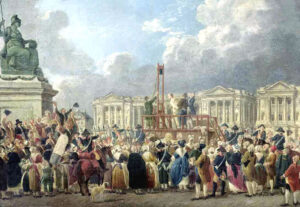
An Execution, by Pierre-Antoine Demachy (1793) / Wikimedia Commons / Musée Carnavalet, Paris
Below, I shall attempt to reconstruct the story of a suicide committed by a once-great culture.
Since the French Revolution, the soul of the Western intellectual has been fatally poisoned by a passion for revolutionary madness and the dream of a “strong leader”.
Thomas Carlyle didn’t hide his admiration for “the Incorruptible” Robespierre (“the incorruptible sea-green Robespierre”), and called the French Revolution, with its Jacobin terror and mass atrocities, “the crowning phenomenon of our Modern Time”.
The 20th century created new idols. Walter Duranty, an Anglo-American journalist who served as the Moscow Bureau Chief for The New York Times, ardently denied the Holodomor: “There is no actual starvation or deaths from starvation… Any report of a famine in Russia is today an exaggeration or malignant propaganda.” (Up to 4.5 million people died in Ukraine alone during the Holodomor of 1932–1933. Today, that same New York Times grieves over a ‘famine in Gaza’, where about 560 tons of food are delivered per day).
Bernard Shaw, Romain Rolland, Aragon, Barbusse, and Jean-Richard Bloch glorified Stalin! Rolland praised Stalin for his “modesty and humanism”.
Bernard Shaw fully agreed with him. From his point of view, everything was just marvelous. The Holodomor? “…I saw no underfed people there; and the children were remarkably plump” (though cannibalism was the norm in many places in Ukraine). The “Red Terror”? “Malicious inventions driven by class hostility.” The “Dictatorship of the Proletariat”? In Russia, “the proletariat is much more effectively dictated to for its own good than under our system.”
His admiration for Lenin, Stalin, and the Bolsheviks, however, did not preclude him from admiring Hitler and Mussolini. He felt a strong sympathy for a “personal friend of mine, Sir Oswald Mosley”.
Barbusse authored an apologetic biography of Stalin: Stalin: A New World Seen Through the Man. He was convinced that the establishment of Soviet Russia was “the greatest and most beautiful phenomenon in world history”.
Let’s guess: who is writing about whom? “Lonely, overbearing man… damned disagreeable,” “friendly and commonplace,” possessing “an intelligence far beyond dogmatism,” […] “sucked thoughtfully at the pipe he had most politely asked my permission to smoke… I have never met a man more fair, candid, and honest.” Got it? It was Stalin, as portrayed by H.G. Wells. They talked for three hours in the Kremlin and… “discussed liberty of expression”.
“I would do nothing against Stalin at the moment; I accepted the Moscow trials [against Trotsky-Zinoviev ‘traitors’ – author’s note] and I am prepared to accept those in Barcelona,” said the French novelist André Malraux during the Communists’ massacre of POUM (Workers’ Party of Marxist Unification) anarchists in Barcelona in 1937, during the Spanish Civil War.
Mao Zedong, “The Red Sun in Our Hearts,” illuminated the path for Jean-Paul Sartre and Simone de Beauvoir. Chairman Mao’s “Red Guards” caused the deadly convulsions of China – and the ecstatic rage of Jan Myrdal, Charles Bettelheim, Alain Badiou, and Louis Althusser.
In Paris, Barbusse and Aragon created a “pocket monster”—Enver Hoxha in Albania; at the Sorbonne, Sartre worked out an apology for the “Khmer Rouge Revolution” of Pol Pol, Hu Nim, and Ieng Sary. Sartre’s driver and bodyguard was Hans-Joachim Klein, a participant in the OPEC headquarters hostage-taking in Vienna and a comrade of the infamous “Jackal”, Ilich Ramírez Sánchez. Together, they visited the leftist extremist Andreas Baader, one of the leaders of the Red Army Faction (RAF), also known as the “Baader-Meinhof Group”, in Stammheim Prison in December 1974.
The hatred for the “petty bourgeois philistine” – as Trotsky dubbed ordinary people – together with the dream of guillotines, bayonets, and “red terror”, continues to inspire Western intellectuals.
Juan Benet, a famous Spanish writer, declared: “I am strongly convinced that while people like Aleksandr Solzhenitsyn exist, concentration camps will and should operate. Probably it’s worth strengthening the guards, so that people like Solzhenitsyn would not escape.”
Gareth Porter, an American historian, investigative journalist, and winner of the Martha Gellhorn Prize for Journalism, stated in May 1977: “The notion that the leadership of Democratic Kampuchea adopted a policy of physically eliminating whole classes of people was… a myth.” (Up to 3 million people died in Cambodia at the hands of the Khmer Rouge, led by Pol Pot. Please, tell me again about this ‘genocide in Gaza’.)
Noam Chomsky characterized the proofs of Pol Pot’s genocide as a “third-rate… vast and unprecedented propaganda campaign against the Khmer Rouge.” The experience of the Khmer Rouge regime deeply impressed him.
The brothers Alexander and Andrew Cockburn (whose op-eds periodically appeared in the Los Angeles Times) explained that Stalin did not murder millions of people.
All of this was accompanied by a burning hatred for the West, American values, white people, and Judeo-Christian ideals. Rokhaya Diallo or Rosa Amelia Plumelle-Uribe – author of the book White Savagery: Hidden Genocide from 1492 to Today – use notions like “White savagery” and “White ferocity” (La férocité blanche). The history of the white race has been an endless, appalling horror, claims contemporary philosopher Louis Sala-Molins (as if the history of other races were somehow different).
According to Susan Sontag, an American writer, filmmaker, and philosopher: “The white race is the cancer of human history; it is the white race and it alone – its ideologies and inventions – which eradicates autonomous civilizations wherever it spreads, which has upset the ecological balance of the planet, which now threatens the very existence of life itself.”
Since the middle of the last century, the ‘Red bacilli’ have mutated with the speed of Drosophila: the New Left, Neo-Marxism, Trotskyism, Pacifism, Maoism, Structural Marxism, Anarchism, Anarcho-Syndicalism, Libertarian Socialism, the New Anticapitalist Party, Marxist Humanism, Freudo-Marxism, and so on.
Their adherents take to the streets waving red flags and portraits of Trotsky and “Che” Guevara, dreaming to ‘fuck the system’ like their idol Abbie Hoffman. They fawn over despots and bigots while draping sadists in romantic glory.
“Dead White European Males” (DWEM) is a term invented by modern Western intellectuals to characterize the classics of European literature, philosophy, and art. The key word here is “white”. Nobody would ever dare to call Africans “black”, Asians “yellow”, or Native Americans “red”. Only “whites” “deserve” such contempt.
Pascal Bruckner, a French writer and one of the “New Philosophers”, wrote that the middle class was captured by “bourgeois-bohemian Bolshevism”. Every artist, actor, or journalist imagines themselves a subverter – especially when such subversion is generously paid. Every socialist leader, according to him, dreams of thrusting a clenched fist into the air and singing The Internationale after every party convention.
The “red bacillus” has penetrated deeply into all the social structures of Western civilization. At the beginning of the new millennium, these universalist theories blossomed into a lush and poisonous bloom. New concepts emerged: Identity Politics, Critical Race Theory, Institutional Racism, Intersectionality, “White Privilege / Male Privilege”, and others. Born of the vicious union of Red and Brown dogmas, all of them are pseudoscientific, dividing people into a rigid racial-class hierarchy.
Evil has reached a qualitatively new level.
And then came Islam, and the Western elite embraced it enthusiastically – as a harbinger of the Great Truth – opening their arms wide to welcome it. Michel Foucault, a leading contemporary philosopher, compared Ayatollah Ruhollah Khomeini to Martin Luther and described the unfolding events as an example of a new “political spirituality” (spécificité / spiritualité politique). Jean-Paul Sartre sang the praises of Ali Shariati, the ideologue of the Islamic Revolution. Legal philosopher and international law scholar Richard Falk met in person with Ayatollah Ruhollah Khomeini in Paris in 1979.
They were crazy about the ‘Palestinian resistance’ and full of admiration for Arafat. The French post-structuralist philosopher Gilles Deleuze published a famous essay titled ‘The Greatness of Yasser Arafat’ (La Grandeur de Yasser Arafat), and the equally famous writer and playwright Jean Genet wrote an enthusiastic novel about him and Palestinian fedayeen fighters, Prisoner of Love.
After Arafat’s death, all their ardent, passionate love shifted toward the Islamists. For Judith Butler, Hamas and Hezbollah became “part of progressive social movements”; prominent Italian postmodernist philosopher Gianni Vattimo called on Europeans to launch a fundraising campaign to “buy better rockets for Hamas”; Chomsky hailed Hezbollah as a ‘liberation movement’; Norman Finkelstein praised Hezbollah for its courage and discipline. Leading intellectuals drew inspiration from October 11 and October 7.
And that is just the tip of the iceberg.
With the zeal of deranged cultists, they have brought in Muslims from the darkest cloacae of the Third World; they have handed over their own wives and daughters to be preyed upon; they have allowed them to desecrate their own sacred sites, to rob, humiliate, and terrorize their fellow citizens. They permitted Islamists to establish a cult of a ‘Palestine from the River to the Sea’ and to transform the keffiyeh into a symbol of freedom and virtue.
Now we are witnessing the conclusion of this drama – without pity and without regret. For it is impossible to feel pity for those who have condemned themselves to a harrowing demise.
The ‘Red Plague’ has returned to where it came from. Let us wish it every success. It will help preserve whatever remains normal in this world.
Born in Moscow, Alexander Maistrovoy is a journalist based in Israel and the author of “Agony of Hercules or a Farewell to Democracy (Notes of a Stranger)”, available at Amazon and Barnes & Noble.
