


by WorldTribune Staff / 247 Real News November 8, 2026
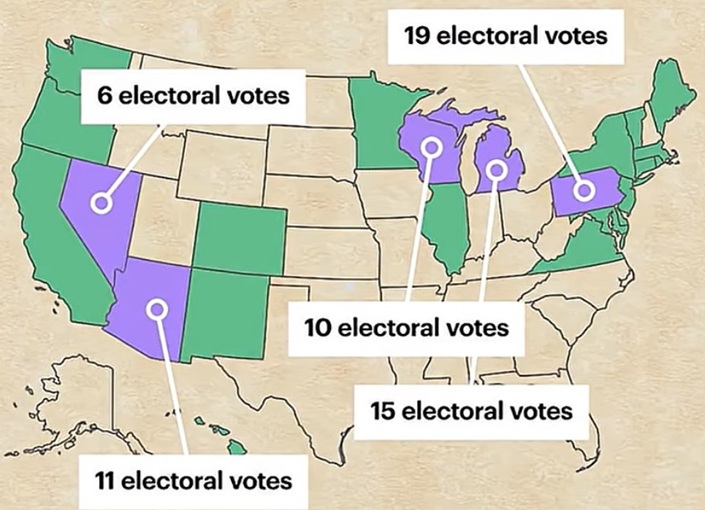
The Nov. 3 midterms saw Democrats gain control of the governor’s office and both legislative chambers in Michigan, Pennsylvania, Wisconsin and Nevada. They now have the votes to enact the National Popular Vote Interstate Compact, which bypasses the Electoral College and gives delegates to the winner of the presidential popular vote.
Enacted by 18 states and Washington, DC prior to Nov. 3, the compact has 222 electoral votes pledged to it. If Michigan, Pennsylvania, Wisconsin, and Nevada join, their combined 50 electoral votes would push the compact to 272 and activate it.
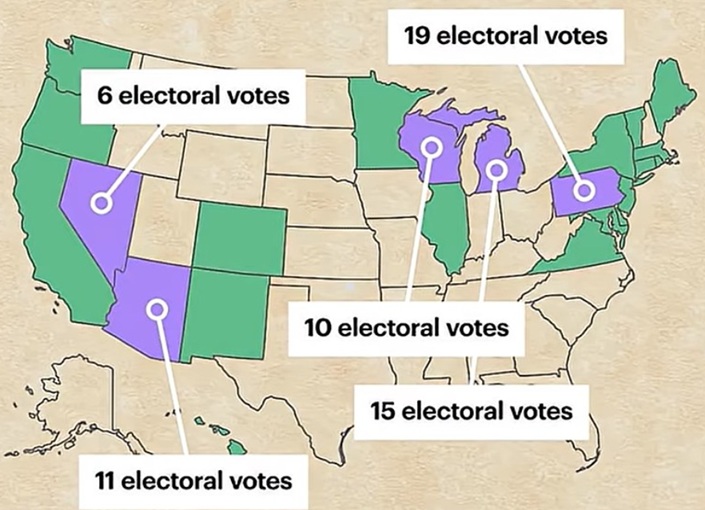
Will Michigan, Pennsylvania, Wisconsin, Nevada, and Arizona join the states in green in the National Popular Vote Compact?
Arizona could push the total to 283 if Democrats ultimately gain control of both chambers there.
“National Popular Vote (NPV), the nonprofit organization that authored the compact and is campaigning to enact it state by state, says it has identified multiple legislative sponsors in each of the five states whose combined electoral votes could push the compact over the 270-vote threshold. It expects bills to be pre-filed before, or introduced early, in the 2027 legislative sessions,” Fox News Digital reported on Sunday.
“I am confident we have multiple paths to secure the 48 electoral votes required to deliver what 63% of Americans want,” Patrick Rosenstiel, a senior consultant for NPV, told Fox News Digital.
NPV contends that, under Article II, Section 1 of the U.S. Constitution, individual state legislatures hold the plenary power to direct how their state’s electoral votes are allocated. Supporters and legal proponents argue that because states already possess the right to award electors based on a winner-take-all system or by congressional district, they have the right to pledge them to the national popular vote winner.
Opponents and legal scholars argue that the compact may violate Article I, Section 10 of the U.S. Constitution (the Compact Clause), which requires congressional consent for interstate compacts that encroach upon federal power or alter the structural balance of the republic. Critics also argue it bypasses the formal constitutional amendment process required to alter or abolish the Electoral College.
So, could the National Popular Vote Interstate Compact actually be officially enacted by the 2028 presidential election?
“They can’t use a compact to, in essence, change the Electoral College,” Hans von Spakovsky, an election law expert with the conservative group Advancing American Freedom, told Fox News Digital.
“This is unprecedented,” von Spakovsky, a former commissioner on the Federal Election Commission (FEC), continued. “In the past, the only kind of compacts that have been agreed on between states have been things like water sharing — when rivers run between states, they enter into compacts to agree on that. But a compact that changes a fundamental structural given in the Constitution, I think the Supreme Court would say you can’t do that.”
Von Spakovsky added that states choosing not to participate in the National Popular Vote Interstate Compact would have a strong basis for litigation.
“Given that the NPV is entirely a creation of Democrats and only supported by Democrats, the new Congress will no doubt easily pass this compact,” he told Fox News Digital. “However, I believe the non-participating states would have a good basis for litigation, which would end up in the Supreme Court, arguing that the compact is unconstitutional because it changes a fundamental structural part of the Constitution without going through the constitutional amendment process. The argument would be that states cannot make agreements among themselves that damage the federal system provided by the Constitution.”
