


by WorldTribune Staff, September 30, 2026 Non-AI Real World News
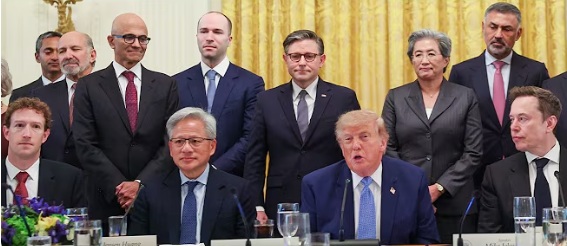
President Donald Trump and major Big Tech executives signed a voluntary, “morally binding” self-regulation agreement for artificial intelligence (AI) during a White House summit on Tuesday.
Trump and House Speaker Mike Johnson announced the pact after a closed-door lunch with tech leaders.
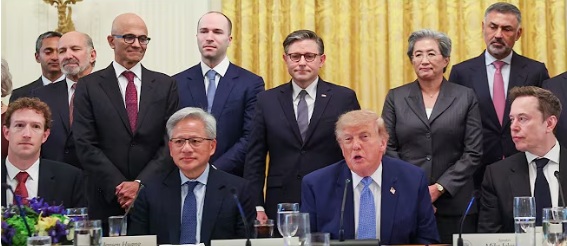
President Donald Trump and leaders of top U.S. tech companies met for an AI summit at the White House on Tuesday. / Video Image
Key details of the agreement:
• Termed the White House Accord on Super Intelligence (shifting the official term from AI to SI).
• Signed by leaders from Anthropic, OpenAI, Google, Meta, xAI, and Nvidia.
• Described by Trump as “almost like a constitution, in a way.”
• Declared “morally binding” rather than legally enforced by federal mandates.
Core principles and self-regulation:
• Four layers of internal controls and audits.
• Monitoring cyber, biological, and chemical security threats.
• Empowering internal safety teams to oversee models.
• Supporting local communities impacted by massive data centers.
Industry and administration stance:
• Rejects heavy federal legislation or industry slowdowns.
• Relies on existing law enforcement like the FBI and DOJ.
• Focuses heavily on voluntary industry self-policing
“There’s a belief that there should be tremendous self-regulation,” Trump said during the lunch as he sat between Meta’s Mark Zuckerberg and Nvidia’s Jensen Huang on his right and XAI’s Elon Musk and Google’s Sundar Pichai to his left.
“We automatically have regulation with the Department of Justice, the FBI, all of that. But the self-regulation is very important.”
Trump and six of the CEOs signed a one-page document titled the “White House Accord on Super Intelligence: Joint Commitment on Frontier Responsibilities.”
“The biggest people in the world signed that, and I signed it as president, and it really is a form of protection… I think it’s morally binding,” Trump said.
Zuckerberg said the agreement would yield “multiple layers of auditing and controls, starting with internal risk review, external auditors and evaluators, and agreeing that we’re going to have all of our boards of directors independently review the reports that come from the auditors.”
“The idea isn’t that this is the only thing that we will ever do. It is that this is a start and an accord that the whole industry could come to,” Zuckerberg said.
The Big Tech companies will designate internal teams to track compliance. External auditors will conduct independent reviews, with a committee of each company’s board of directors in charge of “ensur[ing] any issues identified are remediated.”
The six companies “will meet regularly to establish standards and best practices to improve the safety of their systems,” the document says, adding, “Over time, it may make sense to codify these steps into laws or regulations.”
Polling shows 71% of Americans think the federal government is doing too little to regulate AI. Trump also fended off questions regarding Microsoft founder Bill Gates’s claim Sunday that AI could cause “a billion deaths” if mismanaged.
Trump said there was nothing to fear because the firms would be “policing each other” and “if something goes wrong, their companies are at stake.”
Trump said that if he learned of catastrophic threats, “I’d come out here, I’d hold a news conference, and I’d let the world know about it.”
“We have a very big lead, and we’re going to keep our lead, and it’s a very positive thing. It’s an amazing industry,” Trump said, alluding to China’s attempt to surpass the U.S. in AI technology.
“We’re leading, and we’re going to keep it that way,” Trump declared.
