


by WorldTribune Staff, October 22, 2026 — Real World News
The commander of U.S. forces in South Korea and the leftist government in Seoul don’t agree on the critical issue of who would command joint forces if North Korea were to again invade the South as it did at the outset of the Korean War.
South Korean President Lee Jae-Myung is pushing for the rapid return/transition of wartime operational control (OPCON) from Washington back to a South Korean four-star general.
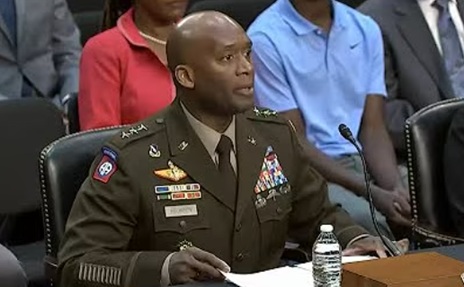
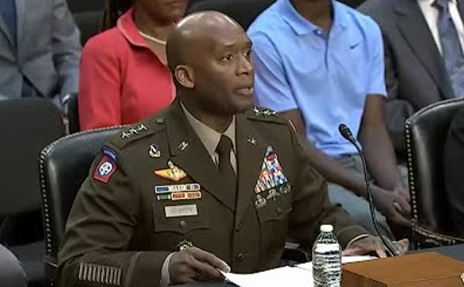
Gen. Xavier T. Brunson
Gen. Xavier T. Brunson, who leads three major bodies: U.S. Forces Korea (USFK), the U.N. Command, and the South Korea-U.S. Combined Forces Command, doubts if “conditions” are right for transferring OPCON to Seoul in wartime.
Brunson and other U.S. military officials have expressed caution and skepticism about shifting or delaying/changing conditions too quickly, arguing that the alliance is not yet ready for a South Korean general to lead the combined framework or guarantee immediate U.S. mainland reinforcements under a hastily transferred command.
Recent remarks by Brunson regarding the Demilitarized Zone (DMZ) and his reservations over the wartime command transfer have sparked political friction and pushback from South Korea’s leadership, who view the current setup as an issue of national sovereignty.
Brunson, the commander of America’s 28,500 troops in South Korea, said the risks have escalated to the point that it would be premature for South Korea to be in charge of defense in a second Korean War.
Writing for The New York Sun on Oct. 20, columnist Donald Kirk noted: “South Korea has long since taken command of its own troops in time of peace, but military leaders have been wrangling for years over ‘OPCON’ in wartime.”
Lee, reflecting pressure from anti-American members of his ruling Minju or Democratic Party, said that entrusting OPCON “to another country and relying on it cannot be left as it is.”
Brunson “triggered fresh debate in the aftermath of the mine explosion along with North Korean missile tests,” Kirk noted.
In response to a Korean reporter’s question at the Center for Strategic and International Studies at Washington, Brunson made clear he supports “a condition-based OPCON” but doesn’t think the desired “conditions” have been met.
“If the President and Secretary of Defense ordered the OPCON transition immediately, I would respond, ‘Yes,’ but I would clearly report the associated risks,” he said, “A quick glance at the newspaper would show that the conditions have clearly changed.”
North Korean leader Kim Jong-Un’s sister, Kim Yo-Jong did not dispute the image of rising danger, saying: “The risks have escalated sharply. A grave situation is prevailing along the southern border due to the reckless behavior“ of South Korean “military gangsters.”
Kim Yo-Jong then raised the specter of North Korea “deploying more tactical strikes along the southern border as a preemptive and suppressive measure.”
North Korea, she added, might resume “loudspeaker broadcasting” from its side of the 2.5-mile-wide demilitarized zone that’s divided the two Koreas since the signing of the Korean War armistice in July 1953. North and South Korea have periodically blasted one another with propaganda barrages over mega-loudspeakers. South Korea has also broadcast K-Pop hits for North Korean soldiers dug in on the other side.
The South’s defense ministry has charged the North with implanting mines on the South Korean side of the barbed-wire border in the middle of the DMZ, including the one that injured the South Korean soldiers. Seoul also accuses the North of having strengthened the barbed wire. Kim and his sister have denied all such claims.
Kirk noted that “Lee mentioned none of that while insisting that South Korea was ready to command its own troops in case of war. He appeared uncertain how strongly to criticize the North while looking for an opening for talks with Kim Jong-Un but was firm about South Korea controlling its own troops while battling for survival.”
“OPCON must be returned at an early date,” Seoul’s Yonhap News quoted Lee as saying. “(We) should definitely shoulder (our defense) on our own, and I think we are sufficiently capable of doing so.” At the defense ministry, a spokesperson remarked, “If the goalposts keep moving, the OPCON transition will never happen.”
Brunson painted an alarming picture of rising tensions from the Middle East to Northeast Asia: “The North Korean military is maturing,” he said, because of its combat experience on the Russian side in the war for Ukraine. “We have to make sure we have the relationships, the interoperability in place.”
He left the impression that North Korea’s experience in the Ukraine war was one more reason for delaying OPCON.
“We could be found wanting in some areas,” Brunson said, but he saw America’s separate treaties with South Korea, Japan and the Philippines as standing against North Korea’s benefactors, Russia and China plus Iran, which North Korea has supported with missiles, drones and the technology to produce them.
“Our only forces on the Asian continent are in Korea,” he said. “We got an enviable posture by virtue of our friends in the region.” Now, he said, “the onus is on us” to make the Korean public, and the defense ministry, “aware of what we are doing.”
