


by WorldTribune Staff, August 9, 2026 Non-AI Real World News
Saudi Arabia, Turkey, and Pakistan the world’s top Sunni Muslim powers, have established a NATO-style collective deterrence model which analysts believe is aimed squarely at Iran and Israel.
The “Mecca Joint Defense Pact” was formalized on Friday as Saudi Arabia braced for expected coordinated drone and missile strikes from Iran-backed Iraqi militias and Yemen’s Houthi terrorists.
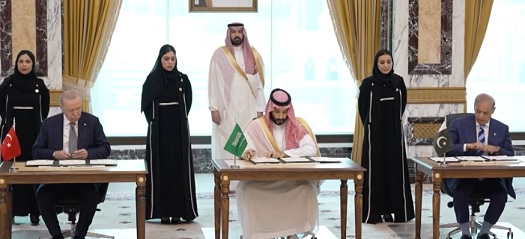
From left, Turkish President Tayyip Erdogan, Saudi Crown Prince Mohammed bin Salman, and Pakistani Prime Minister Shehbaz Sharif sign on to the Mecca Joint Defense Pact. / Video Image
“While seen initially as a bulwark against aggression by Shia Iran and its Middle East proxies,” the agreement “has major implications for Israel and for NATO, of which Turkey is a key member,” David Jones noted in a Sunday analysis for The New York Sun.
The new pact “may not be seen as unwelcome by President Trump, who has been pushing America’s allies in Europe, Asia, and elsewhere to take more responsibility for their own defense,” Jones noted.
“However the pact also reduces pressure on Saudi Arabia to recognize Israel as a hedge against Iranian power — a step Mr. Trump has demanded as a condition for helping Riyadh to develop a nuclear power capability.”
Related: Iran-backed militia in Iraq attacked Gulf Arab states during new PM’s trip to U.S., August 4, 2026
The pact states that an armed attack on any of the three countries will be regarded as an attack on all three. Details remain vague and it is unclear what level of military response would be required and under what circumstances.
The three nations have a combined population of about 372 million and a combined military budget of $125 billion, establishing the bloc as one capable of reordering security considerations across the Middle East.
The president of Israel’s Shahvand Think Tank, Raghu Kondori, wrote for the Times of Israel that Saudi Arabia “contributes financial power, energy influence, and a central position in the Gulf” to the new alliance. “Turkey possesses a substantial military-industrial base and one of the region’s most capable conventional forces. Pakistan provides extensive military experience and the strategic weight of a nuclear-armed state.”
Kondori also points out that “any future Israeli operation affecting the Gulf or involving Iranian-linked targets would also have to consider the possibility of a coordinated response from three powerful regional states.”
“For Israel, the pact may reduce the diplomatic leverage that normalization with Saudi Arabia was expected to produce,” Kondori added. “It does not necessarily end the possibility of Saudi-Israeli normalization, but it gives Riyadh an additional strategic option and greater bargaining power.”
A nonresident senior fellow at the Atlantic Council’s Turkey Program, Rich Outzen, wrote on the council’s website that Saudi Arabia “sees important counterweights to Iran (as does) Pakistan to India, but for Ankara adding an economic giant and a nuclear power to its team sharply enhances deterrence against Israel, a neighbor whose leaders increasingly speak of enmity and potential conflict with Turkey.”
“In the wake of last year’s Israeli airstrike on Doha,” he adds, “countries in the region may see the need for collective air defense and other security measures to counter both Iran and Israel.”
Several analysts are saying the deal reflects a desire by the member countries to reduce their security dependence on the United States.
“This new agreement is also further evidence that Riyadh is abandoning its quest for an Article 5–like security guarantee from Washington,” wrote Allison Minor, director of the Project for Middle East Integration at the Atlantic Council.
“But it should not be seen as a rejection of Riyadh’s partnership with the United States. In fact, it could be consistent with U.S. efforts to recalibrate its own military role in the region and shift from a security guarantor to an integrator,” Minor added.
