


Special to WorldTribune.com
 By John J. Metzler, October 7, 2026
Beyond a handful of high profile and sometimes controversial speeches before the UN General Assembly, few addresses reached the high points of oratory or even the level of more than ho-hum pedantic palaver.
Of the 193 speakers, most addresses fall into the category of checking the political boxes, covering key or perceived global concerns, or simply getting fleeting attention for their far-flung countries.
The political flavor and tone of the 81st Assembly included Artificial Intelligence, Palestine/Gaza, Global Inequality and the plethora of humanitarian crises and of course maritime security.
‘We also need to rebuild our institutions and culture. We need to protect and value the family and strengthen the social significance of parenthood.’
Let’s look at a some interesting views from regional states.
Japan’s Prime Minister Takaichi Sanae stated a overlooked truism; “The ‘stable post-Cold War era’ is now a thing of the past.” She added, “For many years, we have engaged in dynamic trade in the free and open seas spanning the Pacific Ocean to the Indian Ocean, and together, we have built a strong and prosperous region.”
Yet she conceded, “However, due to the recent intensification of geopolitical tensions, free trade has been hampered, and stable energy supplies, and supply chains in general, have been disrupted.”
Moreover Prime Minister Takaichi was one of the few delegates to call out North Korea’s communist regime:
“The advancement of North Korea’s nuclear and missile programs, as well as its use of malicious cyber activities, including cryptocurrency thefts as a source of funding, are clear violations of relevant Security Council resolutions and pose a serious threat to international peace and security.”
Despite UN Security Council sanctions, the North Koreans recently tested another improved intermediate range strategic missile which poses a direct threat to Japan and South Korea.
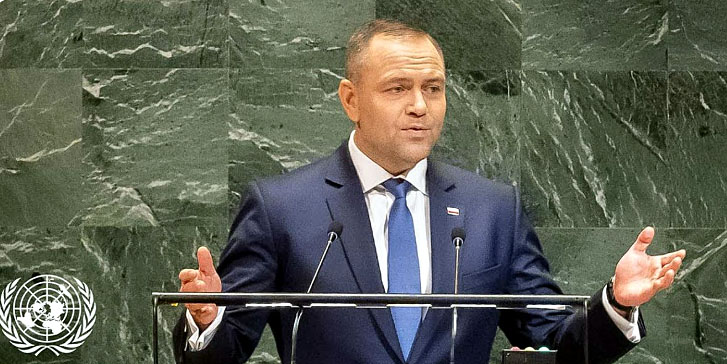
Poland’s President Karol Nawrocki proudly proclaimed that, “Today Poland is the world’s 20th-largest economy. Our path to becoming a developed nation was not a matter of chance, but the result of consistent reforms”.
Poland is a member of the European Union and NATO offering the institutional and security framework for success. Yet he added, “Russia is destabilizing the situation in Europe through open aggression, hybrid operations, acts of subversion and sabotage, and by ignoring successive resolutions of this Assembly.” He stressed, “The Russian Federation, guided by an imperial and neocolonial vision of the world, is attempting to impose its will on others. In doing so, it is effectively challenging the right of every nation to determine its own destiny.”
But then he switched to another overlooked threat, “One of these is the demographic crisis. This is not merely a matter of statistics, but a challenge to civilization itself. Aging societies, falling birth rates, and the erosion of social bonds are undermining the foundations of our nations.”
“The response cannot consist solely of economic measures. We also need to rebuild our institutions and culture. We need to protect and value the family and strengthen the social significance of parenthood. Yes, the family, mother and father, and an appreciation for their roles are the first step toward overcoming the demographic crisis!”
He stressed:
“Without enduring communities and strong families, there will be neither stable development nor long-term security. Let us do everything we can to ensure that culture and the mass media promote having children, not aborting them!”
Slovenia’s Prime Minister Janez Janša opined, “The United Nations was founded on universal principles: sovereignty, equal dignity, the rule of law, the peaceful settlement of disputes, and the protection of human rights. But principles lose their meaning when they are applied selectively.”
The UN, for decades, has devoted significant attention and adopted “resolution after resolution” to the Palestinian question.
He asked rhetorically, “the suffering of Palestinian and Israeli civilians deserves serious and sustained consideration. Every civilian life matters. But are we applying the same standard of urgency when victims are elsewhere?”
“Last year alone, over four-thousand eight hundred Christians were killed because of their religion. More than three hundred million Christians around the world suffer discrimination and persecution. In Iran, the criminal theocratic regime has brutally murdered tens of thousands of its own citizens this year alone,” he intoned adding, “So, we must ask: if every civilian life matters, why does our urgency seem so different from one crisis to another?”
Addressing the human rights dimension which springs from so many political crises becomes critical. What of the persecuted Christian communities in the Middle East or Nicaragua for that matter?
Naturally these are notable speeches; not so much in soaring rhetoric but in studied and focused policy over which few delegates wish to tread.
John J. Metzler is a United Nations correspondent covering diplomatic and defense issues. He is the author of Divided Dynamism the Diplomacy of Separated Nations: Germany, Korea, China (2014). [See pre-2011 Archives]
