


by WorldTribune Staff, July 22, 2026 Non-AI Real World News
During South Korea’s June 3 local elections, voters at what are considered conservative-leaning polling places were confronted with a lack of ballots.
Residents chanted, “Election fraud,” “Invalid election,” and “Stop counting.”
Reports on subsequent street protests about multiple election irregularities were carried by some of the South’s major legacy media outlets, even dominating the front page of The Chosun Ilbo, the oldest and largest Seoul daily
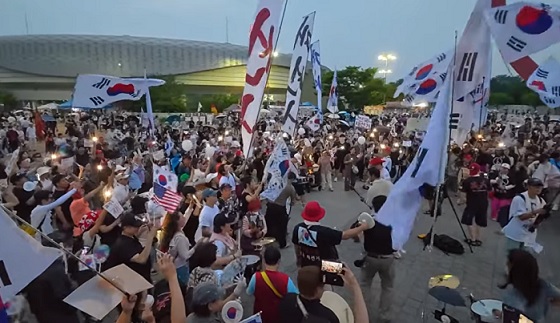
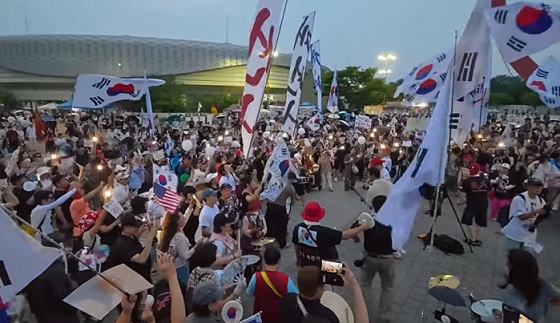
Demonstrators at Olympic Park wave South Korean flags. Many also carried American flags, which have become a common feature of South Korea’s conservative movement. / Video Image
Related: Fraud becomes the headline, tainting election day in South Korea, June 3, 2026
But what has happened since has gone largely unreported like earlier protests claiming corrupt since 2020.
Demonstrators chanting “election fraud” and “rerun the election” have been holding a protest all day, every day, at Olympic Park in Seoul since June 5.
Older supporters of the protest typically attend during daytime hours, while younger participants join after work or school, describing on social media the rallies as an around-the-clock effort.
[The following is excerpted from a July 10 op-ed by Seoul National University Professor Emeritus Lee In-Ho, who served as South Korea’s Ambassador to Russia and Finland. She also taught history at Korea University and Seoul National University and served as the Chairwoman, KBS Board of Directors. It was published by the East Asia Research Center:]
The protests taking place at the Olympic Park in Jamsil neighborhood, Seoul, South Korea, in defense of the right to vote were triggered by the absurd incident of a shortage of ballots. [Note: During the nation-wide local elections on June 3, 2026, one of numerous irregularities was ballot shortages in 91 precincts across South Korea, resulting in many registered voters unable to vote. The National Election Commission (NEC) decided to deliver only 50% of the ballots to certain precincts, especially in areas with more conservative voters.]
But the matter cannot end with the resignation of the current leadership of the National Election Commission (NEC) or the re-holding of the June 3rd elections. The suspicions of electoral fraud that have been accumulating among awakened citizens for over twenty years, the unresolved discontent with the NEC’s approach to election administration, and concerns about the future of the Republic of Korea as a democratic republic have at last begun to erupt as popular rage. The realization that the NEC’s repeated “mistakes” over the past two decades were likely facets of deliberate fraud — and the demand for accountability — has now begun.
Forces across the political spectrum — the ruling party, the opposition, the media, and the general electorate — those anxious not to lose even a sliver of their vested interests regardless of where the country ends up, have long turned a blind eye to blatant violations of electoral law laid bare before them. Yet the younger generation in their 20s and 30s — still possessed of clear souls and sharp intellects who know they cannot live without the air of freedom — have sensed in their bones that their fundamental rights as citizens are being trampled and their futures as members of a democratic state are being blocked, and have stepped forward at the forefront of vigorous protest. It is worth noting that beneath their courageous actions lie a deep undercurrent of disappointment and distrust toward the establishment as a whole — the ruling and opposition parties, the media, and the business world alike — all of whom rush to protect their vested interests in the face of injustice.
The resignation of the current NEC leadership or the re-holding of the local elections does not constitute a definitive solution. Based on facts already made public, suspicions of fraud large and small surround not only this June 3rd local elections, but virtually all elections held in past years. In the harsh reality of international politics, no vacuum in state governance can be permitted; it is a lamentable reality that we must resort to stopgap measures that acknowledge the need to compromise with political forces that seem indifferent to the “formal” legitimacy of those in power or to the welfare of the people. But without a thorough investigation and strict accountability for those who have effectively run the NEC over the past 20 plus years, a re-election is both impossible and meaningless. Replacing a few members of the current leadership will serve only as a means to minimally placate the public discontent with gross election integrity failures while concealing vital evidence of criminal activity — it will not amount to victory for the movement to defend the right to vote, nor a genuine restoration of sovereignty for all the people of the Republic of Korea.
The struggle for fair elections is not a task unique to us. History across all times and places shows no exception to the temptation of fraud, great or small, in elections. But in the past twenty-five years, there has been no precedent like that in the Republic of Korea, where the NEC has so openly violated electoral law and election results have been distorted yet tolerated — at least not in a country that claims to be a democracy.
First, the NEC replaced the internationally recognized procedure for blocking the insertion of fraudulent ballots — the manual stamping of each ballot by election officials with their own seals — with stamps already pre-printed on the ballots. This is a procedure that cannot be perfectly replaced by barcodes or serial numbers, and it is the system that guarantees the credibility of recounts. Moreover, it requires less money and organization to implement, yet in defiance of citizens’ demands to restore this safeguard, what was done only for the relatively new procedure of early voting [printing the stamps on the ballots as each early ballot is printed from a printer on site — which also disregards the safeguarding purpose] was extended to election-day voting as well this time. Why?
Second, the NEC disregarded the principle prohibiting the breaking of ballot box security seals. The NEC used defective seals that do not leave any trace when removed, which defeats the purpose of preventing tampering. In addition, the early vote ballot boxes in storage were accessed, seals removed to add extra ballots, and then resealed — all recorded on CC cameras in the storage rooms.
Third, the events that unfolded after the introduction of electronic vote-counting machines based on China’s Huawei system — already a subject of security-level vigilance in the United States and elsewhere — appear to belong to a category of international large-scale crime that cannot be adequately discussed in this space. The consistently observed gap at a certain ratio between election-day and early voting results was enough to raise doubts even for those who are not statisticians or computer experts. What confirms the possibility that this was not a natural phenomenon but the result of manipulation is the fact that the NEC continuously resisted or dismissed the requests of the President [Yoon] and the National Intelligence Service to verify the possibility of external penetration of the NEC’s servers.
Fourth, regarding the NEC’s lax management, overreach, and nepotism, there is already more than enough material made public in the media. The NEC, which received massive budgetary support with the expectation that it would uphold the backbone of democracy and maximize the national interest through fair and efficient election administration, went in precisely the opposite direction. More than one or two traces have appeared that raise suspicion that the NEC — being neither an elected nor a professional body — unnecessarily involved itself not only in observing foreign election systems but even in the introduction of election equipment, earning the country a bad reputation that the equipment South Korea exported was the cause of fraudulent elections, and that the NEC was engaged in treasonous acts that opened a wider path for foreign hostile forces to penetrate our elections. Looking at the recently published book The Dandong Project, co-authored by Kim Mi-young and Roy Kim, the NEC’s criminal misconduct appears to have reached the level of an international criminal cartel, not confined to the domestic sphere. The content of The Dandong Project has credibility because it is based on events that were already widely reported in the international community, even if blocked domestically by a corrupted media.
If there is a genuine intention to build and operate a fair electoral system that admits absolutely no room for fraud, there is no shortage of methods for future electoral reform — and at least on the surface, there will be no one in any party or sector, political or otherwise, who would disagree with that goal. Technologies abound for making the voting and counting process transparent and efficient while protecting individual privacy, and the Republic of Korea is not a country lacking the technology or economic capacity to build such a system. From the very beginning, whether or not there exists the intention and will to establish a flawlessly fair electoral system has been the key question.
The people of the Republic of Korea must now face a harsh reality. Today’s Korea is not the Republic of Korea of the early new millennium, when the Soviet Union and the communist bloc in Europe were collapsing — nor even the country that, until just recently, was acknowledged by all, including itself, to have achieved success in both economic development and democratization. We must realize that we are not a normal country in normal times; we are a people continuously under infiltration and attack from enemies within and without. The struggle of young people that began in Jamsil is not merely a fight to secure the right to vote — it is a struggle on which the survival of the Republic of Korea as a free democratic republic depends. Further, it signifies that the struggle — always ongoing, visibly or invisibly, between those who strive to build a world where human conscience and dignity are upheld through the rule of law and democratic institutions, and those who stop at nothing to gain power — has now reached a desperate crossroads where humanity could be socially suffocated. In the context of the shifting balance of global power: if the liberation of 1945, the founding of the Republic of Korea in 1948, and the Korean War represented an experience in which the Korean Peninsula became a frontline in the Cold War between the communist and free worlds, between the Soviet Union and the United States, and our entire nation suffered great sacrifice while South Korea alone [not the entire Korean Peninsula] survived as a democratic state — then the destructive campaign against us that has proceeded in a far more sinister manner behind the façade of “democratization” can be seen as a second Korean War in which we have once again become a frontline in the fierce competition between the United States and China, and as a struggle for the protection and second founding of the Republic of Korea as a free democratic republic.
The current tide of battle is unfavorable to pro-Republic of Korea (ROK) forces. While the established elite of South Korea as a whole have not even sensed that the ground beneath their feet is giving way, underground forces — a combination of socialist true believers hiding behind seductive slogans, pro-North Korea / pro-China / anti-ROK elements, and large criminal organizations — have mobilized their specialty of propaganda and agitation, seized even the extraordinary means of monopolizing the operation of the ROK’s NEC, and have already seized the political high ground and major media outlets. Much of the media and the so-called social leadership class, having surrendered their souls to opportunism, have become easy targets of China’s “Unrestricted Warfare” (hybrid war) and have sold their conscience and human rights — leaving ordinary citizens, desperately short of information, unaware of what is happening, and having the entire country stolen from right under their noses. We have lost the capital and are now standing at the frontline of the Busan Perimeter.
But we have an awakening younger generation, and unlike North Korea, we have a homeland worth protecting. Some of the former activists who once called themselves “progressive” have degenerated into an ugly vested-interest class and attempt to suppress the future leaders of this nation — those with living consciences and discernment — by calling them “right-wing diehards,” but this suppression of the younger generation will fail. Our youths — in their 10s, 20s, and 30s — have the vision and courage to recognize and resist the fact that no topic in history or politics should be beyond question, and that for a state or National Assembly to legally sanctify a particular historical event as untouchable is something that can only happen in the most extreme dictatorships. [Note: “A particular historical event” refers to the Gwangju incident of May 1980.]
No person with a conscience can fail to feel that we are not a “normal country” right now, and that the National Assembly is instead leading the nation down a path of self-destruction. Can it be a phenomenon that could occur without the NEC’s illegal cooperation — five people with absolutely no political experience were elected as National Assembly members, because all of them were defense attorneys for an incumbent president [Lee Jae-myung] who is a convicted felon and criminal suspect; and indicted law violators sit in judgment of judges and prosecutors under a “National Assembly’s” one-party dictatorship? This is a question anyone with trust in the political judgment of voters in the free democratic Republic of Korea — which has grown over eighty years — and capable of sober rational thinking, can ask.
The ballot shortage incident that has now erupted is a case in which the long tail of the NEC’s treasonous conduct, carried out for over twenty years, has been caught — and the tip of the iceberg of treason has been exposed. Investigating and demanding accountability for the June 3, 2026 election and the NEC cannot be accomplished simply by referring the matter to a parliamentary investigation or special prosecutor. Young people who have risen voluntarily to defend the right to vote — a fundamental right of citizens — must themselves take up the work of digging into the NEC’s past conduct. The popular struggle must not stop until those involved with the NEC who have committed great crimes against the state and against human rights have been punished with penalties commensurate with an attempted overthrow of the state. This is not a matter to be divided along partisan, left-right, or regional lines — it is a struggle that no one who wishes to live as a free human being can refuse, and if necessary, we must not hesitate to seek the assistance of international solidarity. We must also bear firmly in mind that the dissolution of the existing NEC or partial re-elections are means to prevent the detonator of corruption from exploding and to conceal criminal evidence — they are not a victory for the movement to defend the right to vote and rebuild the Republic of Korea.
