


Special to WorldTribune.com
 By John J. Metzler, November 27, 2026
Pomp and pageantry characterized the recently concluded APEC Summit in Shenzhen China.
The setting in China’s metropolitan tech-hub just outside Hong Kong and staging was brimming with theatrics and cheering comrades all dutifully on cue to support Chairman Xi Jinping’s People’s Republic.
More than 20 regional Asian and Pacific leaders, including Australia, Canada, Chile, Japan, Indonesia, Mexico, South Korea and Thailand among others, met in Shenzhen, for their annual economic summit. They later became part of the backup chorus to the big event; An historic trilateral China–Russia–U.S. Summit, where the Big Three leaders; China’s Xi, Russia’s Vladimir Putin and United States President Donald Trump, eclipsed the diplomatic limelight.
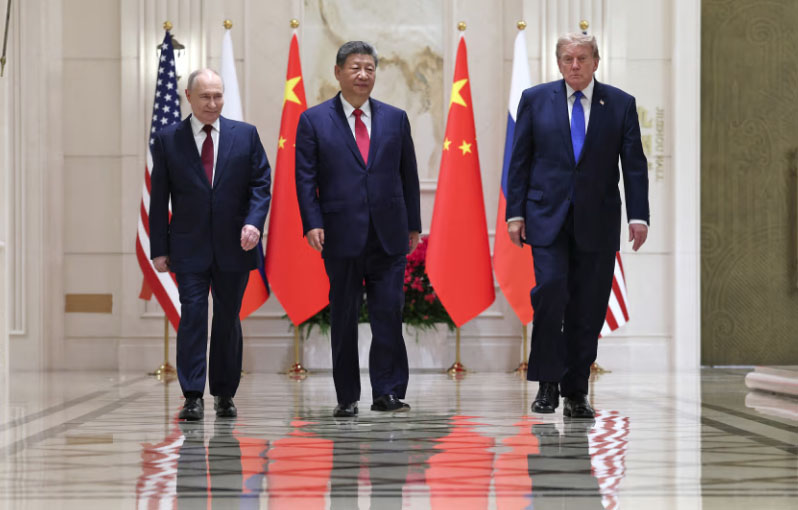
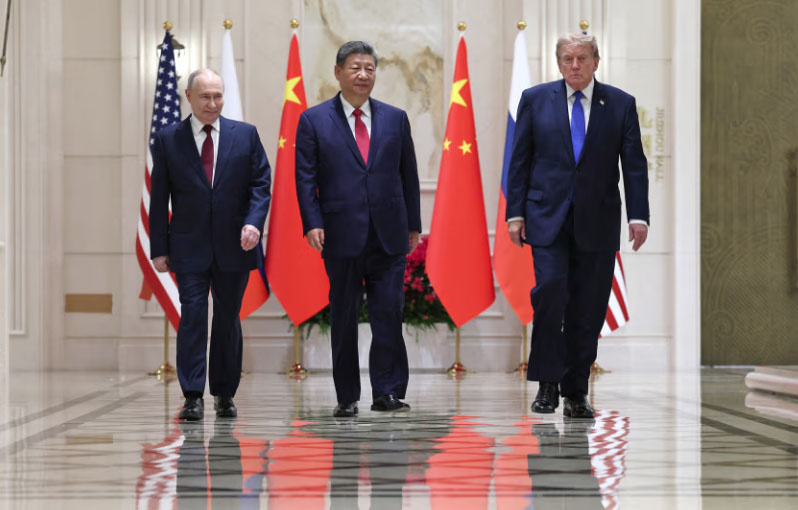
Vladimir Putin, Xi Jinping and President Donald Trump in Shenzhen, China on Nov. 19, 2026. / Video Image
The summit, on Chairman Xi’s territory and terms shrouded the People’s Republic of China in a warm glow of spectacle and seeming stability. Yet the meetings of the Big Three offered no political breakthroughs nor surprising gaffes. What wasn’t said was probably as important.
Chairman Xi extended the cold shoulder to Japan’s Prime Minister Sanae Takaishi. Beijing’s blatant snub to Tokyo’s female leader reflected the poor relations between the two East Asian powers as much as the personal chemistry between both leaders. On the other hand, China’s Communist Supremo swooned over South Korea’s President Lee Jae Myung, in Beijing’s assertive bid to deepen political relations with Seoul.
Vladimir Putin, the odd man out, for Russia’s ongoing war against Ukraine, did not blink on discussions over a long-awaited cease-fire or peace talks. During a press conference the Russian leader stated, that while he “had previously discussed possible ceasefires in a number of areas” that following Ukraine’s successful attack on Russia’s massive Crimean bridge in Kerch “there will be no negotiations” he stated bitterly. Putin is cornered; he’ll become more dangerous.
Not so ironically as Putin spoke, his military was striking targets in Kyiv, Ukraine’s capital.
President Trump in a bilateral meeting with Xi Jinping wanted to gain China’s help in ending the Ukraine war. Chairman Xi had other plans.
Despite Beijing’s reluctance to put the Ukraine conflict on the agenda, Trump pressed the point, declaring that he and Xi could work together to end the fighting. The loss of life in both sides in the Ukraine war is staggering, and Donald Trump wants to stop what can only be described as modern carnage.
Yet in Xi’s opening remarks, there was no mention of Ukraine. The exchange highlighted a disconnect between Trump’s summit ambitions and Beijing’s political priorities, which despite the professed friendship with President Trump remain politically immutable in support for Moscow’s objectives. Notably, Ukraine was also not mentioned in the final Communiqué.
The Summit Communiqué was vague but significant.
The Communiqué stated, “The three heads of state reaffirmed that a nuclear war cannot be won and must never be fought. The three countries will conduct a dialogue on reducing nuclear risks and preventing the proliferation of nuclear weapons.”
President Trump pressed for nuclear weapons reductions among the world’s top nuclear powers; Russia, the USA and Communist China. The American plan is worth serious analysis. President Trump would like to reduce U.S. weapons stockpiles from the current 3,700. But Russia must reciprocate in a clear and transparent manner. Moscow also holds over 4,400 warheads.
China with 600 nuclear weapons would like to see arms reductions, but not from their stockpiles. In other words, Beijing wants to possess more nuclear weapons before it reduces its stockpiles.
And let’s face it, North Korea, has been developing nuclear weapon now for a generation. Kim Jong-Un’s regime holds an estimated 50 nuclear warheads.
Interestingly, the Final Declaration also stated that the three leaders pledged to “advance reforms of the United Nations.” Clearly important but a reaffirmation of the obvious from three of the five permanent members of the powerful UN Security Council.
But wait, this is just not about simple cost cutting and streamlined management. Much of that’s already been done. The timing here is significant as the global organization is thick into the campaign for a new secretary-general to be chosen by the end of 2026. Currently eight candidates can’t seem to get the requisite support and consensus from all five Permanent members of the Security Council. Both Russia and China are regarded as the spoilers.
Though the Summit did disappoint many, according to retired Brigadier Gen. Mark Kimmitt writing in the National Interest, “It was the first meeting with face-to-face discussions between the three most powerful leaders in the 21st century. In this day and age, that is no small achievement.” Point well taken!
John J. Metzler is a United Nations correspondent covering diplomatic and defense issues. He is the author of Divided Dynamism the Diplomacy of Separated Nations: Germany, Korea, China (2014). [See pre-2011 Archives]
