


by WorldTribune Staff / 247 Real News June 29, 2026
Chief Justice John Roberts and Trump-appointed Justice Amy Coney Barrett voted with the Supreme Court’s liberals in ruling on Monday that mail-in ballots received by states after Election Day can be counted.
The 5-4 ruling permits states to count mail-in ballots that were sent on or before Election Day but are received by state election officials after Election Day.
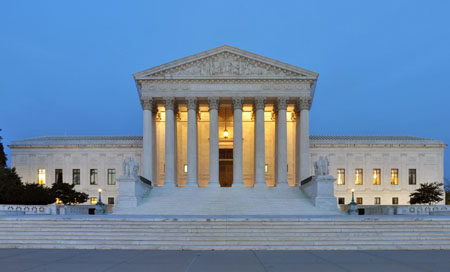
U.S. Supreme Court / Wikimedia Commons
In his dissent, Justice Samuel Alito wrote that the ruling “creates a serious risk of further undermining public confidence in our elections and our system of self-government.”
Barrett wrote the majority’s opinion, joined by Chief Justice John Roberts as well as liberal Justices Sonia Sotomayor, Elena Kagan, and Ketanji Brown Jackson.
“Two principles are important here. First, post-election-day receipt, considered on its own, does not conflict with the election-day statutes,” the Court writes:
“Second, state law is preempted by the federal election-day statutes only ‘so far as the conflict extends.’ So even if plaintiffs are right about Mississippi law, they would still lose the challenge they have pressed in this litigation: that post-election-day ballot receipt is itself unlawful.
“The Framers recognized the difficulty of crafting election laws ‘applicable to every probable change in the situation of the country.’ So instead of constitutionalizing election law, they decided that ‘a discretionary power over elections’ needed to be lodged ‘somewhere.’ Suffice it to say, that power was not lodged in this Court. The election-day statutes say nothing about ballot receipt, and we cannot add to the words Congress chose.”
In dissent, Justice Samuel Alito wrote: “Allowing absentee ballots to pour in over the days and weeks after election day, by which point preliminary election returns are being publicly reported, creates greater opportunity for fraud and risks. It is undeniable that a prohibition on counting late-arriving ballots would provide an additional hurdle for bad actors seeking to stuff ballot boxes when early election results suggest a tight race. The majority incorrectly removes this safeguard from federal law.”
Alito argued that “[i]f ballots received after election day are added to the set of ballots that dictate the election’s outcome, the electorate’s choice does not occur on election day, and the federal election-day statutes are violated.” Mississippi and other states’ acceptance of late-arriving ballots, he wrote, “effectively postpones the date on which the electorate’s choice is made, and federal law precludes that postponement.”
“Today’s decision is inconsistent with the terms of the election-day statutes, contemporary election-law principles, two centuries of historical practice, and the case law on the question presented,” Alito wrote. “And it creates a serious risk of further undermining public confidence in our elections and our system of self-government. I therefore respectfully dissent.”
President Donald Trump said Monday’s ruling amplifies the urgency of passing the SAVE America Act:
POTUS calls out Murkowski, Collins, Tillis, Cassidy, and McConnell by name for protecting fraudulent elections.
Passing SAVE Act is now more important than ever. pic.twitter.com/SPQmXmK9kn
— Liz Harrington (@realLizUSA) June 29, 2026
Critics of the Supreme Court’s decision point to the Los Angeles mayoral primary, where leftist candidate Nithya Raman, who never polled near 40% of the vote, received 40% of the ballots counted after Election Day. Those votes enabled Raman to surpass Independent candidate Spencer Pratt to face incumbent Mayor Karen Bass in November’s runoff.
They were still counting ballots in California three weeks after the June 2 primary.
“The electorate’s choice is made when voting is complete, not when ballots are received.”
Actually, when ballots are received AFTER Election Day the electorate’s choice can be ALTERED, because it’s very easy for cheaters to see how many they need to “win.” (Like Spencer Pratt).… pic.twitter.com/SlGAeEa4MC
— Liz Harrington (@realLizUSA) June 29, 2026
The case is Watson v. Republican National Committee, No. 24–1260 in the Supreme Court of the United States.
Mississippi passed a law in 2020 in response to the Covid pandemic that allows mail-in ballots to be counted so long as they are postmarked by Election Day and received within five days of it. Multiple national and state conservative groups sued, arguing the law clashed with federal law, which in 1845 established Tuesday after the first Monday in November as Election Day.
A three-judge panel of the U.S. Court of Appeals for the 5th Circuit agreed with the challengers of the law, and the full court of appeals rejected the state’s petition to rehear the case. The state took it to the Supreme Court, which agreed in November to review the lower court’s decision, SCOTUS blog reported.
