


by WorldTribune Staff / 247 Real News August 13, 2026
President Donald Trump is calling on the Supreme Court to issue a quick decision on his executive order which directed the U.S. Postal Service to only supply mail-in ballots to states that provide the federal government with lists of eligible voters.
A federal district court in Massachusetts on Tuesday issued a temporary order blocking the order.
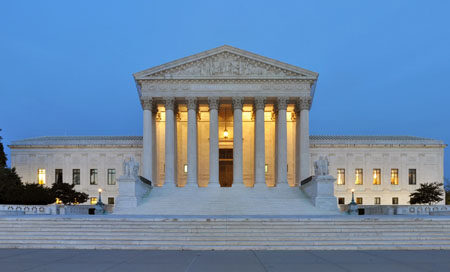
U.S. Supreme Court / Wikimedia Commons
The same court in June blocked other portions of Trump’s order in 23 states and Washington, D.C., related to the Department of Homeland Security’s compilation of a federal voter citizenship list and requirement that states submit voter registration lists to the Postal Service in addition to printing ballots that can be easily tracked.
Both injunctions apply only to the Nov. 3 midterm elections.
Both cases are likely to be addressed by the U.S. Supreme Court soon. The court will essentially decide whether Trump can implement the order for the November elections.
U.S. Solicitor General D. John Sauer wrote to the top court’s justices that “it is critical that the Court act promptly on the pending” request, which was filed on July 27 and has now been fully briefed for more than a week. “Otherwise,” Sauer wrote, U.S. District Judge Indira Talwani’s “erroneous orders will effectively run out the clock on the government’s ability to implement Section 3 of the Executive Order,” which (among other things) bars the U.S. Postal Service from mailing ballots to voters who are not on the lists of eligible voters that the USPS will create “for the federal elections in November.” And that in turn, Sauer contended, will “cause irreparable harm to the federal government, the public, and election integrity.”
President Donald Trump signed the executive order, which bears the title “Ensuring Citizenship Verification and Integrity in Federal Elections,” on March 31.
As it came to the court in late July, the focus of the case was on three different provisions of the order. The first instructs the Department of Homeland Security to create lists of the adult U.S. citizens in each state and to send those lists to states at least 60 days before a federal election. The second provision commands the U.S. attorney general to “prioritize the investigation and, as appropriate, the prosecution of State and local officials … who issue Federal ballots to individuals not eligible to vote in a Federal election.” And the third provision, known as Section 3, requires states to give the U.S. Postal Service a list of voters to whom the states intend to send mail ballots, and it prohibits the USPS from mailing ballots to voters who are not on the lists of “enrolled” voters that the USPS will create.
A group of 23 states, led by California, and the District of Columbia challenged the government’s implementation of the order in a federal court in Massachusetts. Talwani ruled that it was too soon for her to review the challengers’ claims as they applied to federal elections scheduled after Nov. 3, 2026. However, she said, the challengers’ claims with regard to the upcoming midterm elections were “ripe” – that is, ready for review – because the order “created a ‘direct and immediate dilemma’ ” for them. In a decision issued on June 25, she barred the federal government from implementing the challenged restrictions on or before Nov. 3, 2026, in the District of Columbia and the 23 states.
The U.S. Court of Appeals for the 1st Circuit turned down the government’s request to pause Talwani’s June 25 ruling while the litigation continued.
On July 27, the Trump Administration came to the Supreme Court, asking the justices to intervene. Calling Talwani’s decision “extraordinary,” Sauer renewed his argument that the challengers’ claims are not yet ripe for review because the agencies haven’t yet decided how they will implement the order. He also contended that unless the court steps in and puts Talwani’s ruling on hold, the government will be permanently harmed – one factor that courts consider in deciding whether to grant temporary relief – because it “blocks the government’s ability to finalize and implement the President’s proposed policies to promote election integrity for the upcoming federal elections in November.” Moreover, he added, “every day that it remains in place irreparably harms the government, as the start of mail-in and absentee voting in some States is now just one month away.”
In a filing on Aug. 3, the challengers countered that blocking Talwani’s ruling “would allow the federal government to rush out an unprecedented, legally indefensible voter-verification and ballot-interception program that would, among other things, give the U.S. Postal Service far-reaching new powers and responsibilities.” They also emphasized that the 1st Circuit had agreed with them that “the specificity of the EO’s stated timelines and the inescapable legal requirements and impending deadlines that States currently face in facilitating mail-in and absentee balloting for immediately upcoming elections together establish” the kind of “concrete injury” that allows them to sue.
The catalyst for Wednesday’s supplemental brief was Talwani’s decision on Tuesday in a separate challenge to the executive order, this time brought by (among others) the League of Women Voters, that temporarily bars the U.S. Postal Service from implementing Section 3 of the executive order. Sauer stressed that Tuesday’s ruling sweeps even more broadly than Talwani’s June 25 decision because it applies “nationwide on behalf of” the various groups who are plaintiffs in the new case.
Talwani’s Aug. 11 ruling, Sauer argued, “confirms the urgent need for this Court to grant the stay of” her June 25 ruling “and to explain its rationale for doing so.” In particular, Sauer emphasized, Tuesday’s ruling suffers from the same problem as its predecessor: “Courts cannot enjoin implementation of an Executive Order that merely instructs agencies to pursue a proposed policy in a manner that is consistent with laws … unless and until those agencies actually take concrete actions that injure the plaintiffs.”
