


by WorldTribune Staff / 247 Real News July 28, 2026
President Donald Trump on Monday asked the Supreme Court to allow him to fully implement his executive order which imposes additional restrictions on mail-in voting.
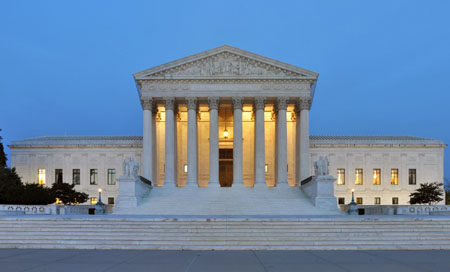
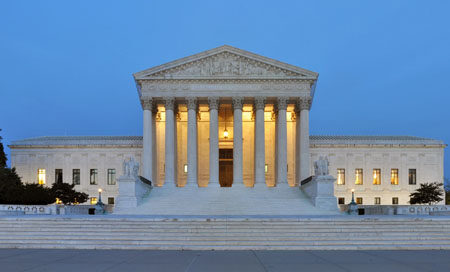
U.S. Supreme Court / Wikimedia Commons
The president signed the executive order at the center of the case, titled “Ensuring Citizenship Verification and Integrity in Federal Elections,” on March 31 of this year.
Trump’s order instructs the U.S. Postal Service to propose rules for mail-in and absentee ballots, and it directs the Department of Homeland Security (DHS) to compile “state citizenship lists” – lists of individuals in each state who are U.S. citizens over the age of 18. Under the order, the rules issued by the USPS must provide that the Postal Service can only send mail-in ballots to voters whose names appear on the state citizenship lists.
A group of mostly blue states and the District of Columbia, led by California, went to federal court in Massachusetts to challenge the implementation of the order.
U.S. District Judge Indira Talwani, an Obama appointee, on June 25 issued an order that prohibited the federal government from implementing the mail-in ballot and state citizenship list provisions for the Nov. 3, 2026, midterms in the states that filed the lawsuit.
U.S. Solicitor General D. John Sauer called judge Talwani’s ruling “extraordinary,” and he argued that it “flouts settled” doctrines governing when courts can weigh in on a dispute.
Sauer asked the Supreme Court to issue an immediate administrative stay – an order that temporarily puts the lower court’s order on hold while the justices consider the government’s request.
In an order issued on Saturday, a divided panel of the U.S. Court of Appeals for the 1st Circuit turned down the government’s request to intervene. If the order were “to take effect for the elections taking place” in the fall, the majority wrote, “it would sow confusion and threaten disenfranchisement of many eligible voters.”
The Trump Administration then came to the Supreme Court on Monday, asking the justices to step in.
Sauer argued that the courts should not yet consider the states’ lawsuit because the agencies haven’t yet decided how they will implement the order. But even if it were appropriate for courts to consider their request, Sauer continued, Talwani’s ruling should be put on hold to avoid “serious irreparable harm.”
“Even if the agencies’ implementation plans end up being entirely lawful,” Sauer wrote, adding, “there is not enough time to obtain ordinary appellate relief from the injunction in order to carry them out before the November election, especially given that any such plans will need to be implemented well before November given the timing of election procedures concerning voter-roll verification and mail voting.”
The court instructed the states to file a response to the government’s request by 4 p.m. EDT on Monday, Aug. 3.
