


Special to WorldTribune.com
 By John J. Metzler, July 15, 2026
How quickly we forget. The cataclysmic earthquakes which devastated large regions of Venezuela recently have paralyzed an already vulnerable country in the midst of chronic social and political instability.
Now yet another level of humanitarian disaster stalks this South American land as the world rushed to provide emergency aid and assistance.
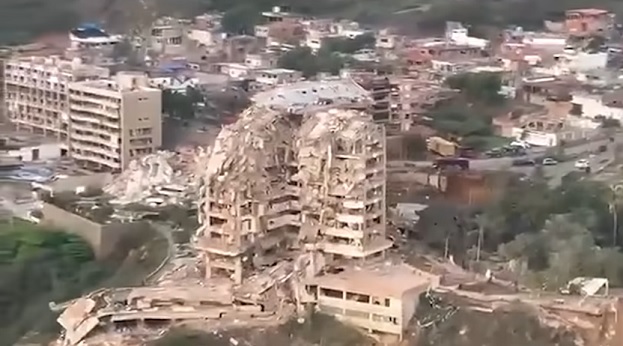
On June 24, merely 39 seconds apart, two 7.2 and 7.5 magnitude quakes hit along the densely populated coastal regions not far from Caracas the capital.
Shock, and dislocation followed as the inevitable aftershocks continued, perhaps the most serious was witnessing the incompetence of the national government to assist its own people.
The UN Office for Disaster Risk Reduction estimates direct quake physical damage to housing and infrastructure at some $37 billion. This figure includes $24 billion in damage to buildings such as homes, businesses, schools and hospitals with a further $13 billion to infrastructure. The UN adds that “telecommunications sustained the heaviest losses, at around $5 billion, followed by energy generation and roads.”
The human cost was daunting; The UN’s Humanitarian Relief Chief Tom Fletcher visiting Caracas speaking alongside representatives from Brazil, the U.S. and the European Commission stated, “People are in shock and despair; formal meetings are not enough,” he said.
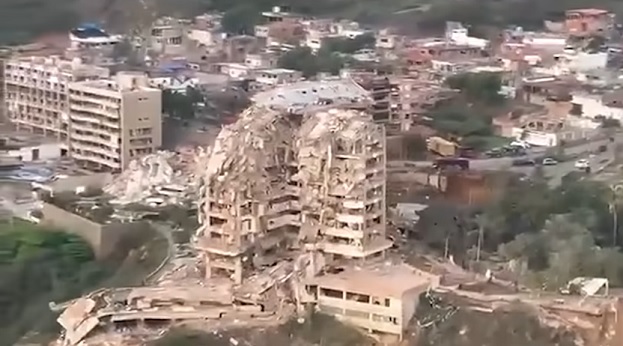
Scientists say the earthquake was actually two separate ruptures, magnitude 7.2 and magnitude 7.5, that occurred just 39 seconds and 5 kilometers apart in northern Venezuela. / Video Image
The quakes have killed more than 4,333 people and injured 16,740 others. Amazingly 6,462 people have been rescued according to the UN relief agency.
The coastal city of La Guaira was amongst the areas hardest hit by the earthquakes. Tom Fletcher outlined, “As we transition from the emergency effort to a wider response, it’s essential we have one coordinated plan.” A combined strategy must cover such urgent priorities as food, shelter and rubble removal, along with long-term recovery and development, he added.
Tragically, the quake impacts a country already suffering from decades of socio/economic decline where nearly eight million people were already receiving humanitarian aid; That’s out of a population of 28 million!
Specifically, the UN Children’s Fund (UNICEF) has warned that children are among those worst affected by the disaster. 650,000 people, including 234,000 children, will need humanitarian assistance. UNICEF adds, “Around a third of schools in the Capital District, which includes Caracas, were damaged, disrupting access to education for thousands of pupils.”
At the request of the Venezuelan Government, 44 international urban search and rescue teams, have deployed 2,245 specialists and 140 search dogs to rescue possible survivors from collapsed structures and provide initial medical care. Shoddy construction and building standards led to a wider crisis.
According to UN Office for Coordination of Humanitarian Affairs (OCHA); teams from the United States, Canada, Argentina, France, Germany, Israel, the United Kingdom and Switzerland among others joined in the race against time to locate survivors.
Major humanitarian donors include the USA $400 million, European Commission $28 million and Germany $9 million.
Once a reasonably prosperous and democratic middle-class society, 25 years of socialist rule first under the left-wing populist Hugo Chavez and later his bumbling successor Nicolas Maduro turned back the clock. Despite its amazing petroleum and agricultural wealth, Venezuela had evolved into a narco-state where corruption, cronyism and a cult mix of Marxism with ties to Cuba and China blended to become the regime’s socialist norm.
In recent years one of Venezuela’s main exports was refugees; The UN High Commission for Refugees (UNHCR) lists more than 7.9 million refugees and migrants from Venezuela. That human calamity preceded the recent earthquake. Most fled to neighboring Latin American countries, but large numbers came into the United States too.
In early January, the United States carried out a successful lightning swift commando raid on Nicolas Maduro’s Headquarters compound; After neutralizing his Cuban security force, they captured the dictator and extradited him to detention in New York where he faces criminal drug-trafficking charges.
Though the Trump Administration toppled the Maduro regime, as a temporary measure it installed Maduro’s sitting Vice President Delcy Rodriguez as interim President of the Republic. That was in January and an understandable expedient to get Venezuela’s oil flowing and keeping its government institutions working.
Now it’s July and Delcy’s acting government has been overwhelmed by this humanitarian crisis.
Yet, there’s an answer waiting in the wings. The leading democratic opposition figure Maria Corina Machado who faced Maduro in a laughably rigged election in 2024 clearly has the gravitas and political legitimacy in Venezuela to assume the presidency.
Ms. Machado was awarded the Nobel Peace Prize in 2025 and was expected to assume the helm of government until free and fair elections in the wake of Maduro’s ousted regime.
So, what are we waiting for?
John J. Metzler is a United Nations correspondent covering diplomatic and defense issues. He is the author of Divided Dynamism the Diplomacy of Separated Nations: Germany, Korea, China (2014). [See pre-2011 Archives]
