


Special to WorldTribune.com
 By John J. Metzler, October 20, 2026
PARIS — A near perfect storm of political, social and economic crises has engulfed France this Autumn; a Debt crisis, Chaos in the Schools, and the legitimization of violence have converged causing a wave of street protests and destruction of property.
The demonstrations coincide with the tumultuous twilight of President Emmanuel Macron’s era whose decade in power has gone from bubbly enthusiasm to sneering disdain.
Dissatisfaction boiled over and chaos exploded in parts of Paris and provincial France.
Weeks of protests have rocked the High Schools, the Lycées, across France as students complained and then rebelled against large 30 plus size classes, too few teachers, and sometimes shoddy school facilities. These protests, combined with a warm Autumn and often deaf responses from bureaucratic officialdom, have lent themselves into being politicized and then hijacked by the political far Left.
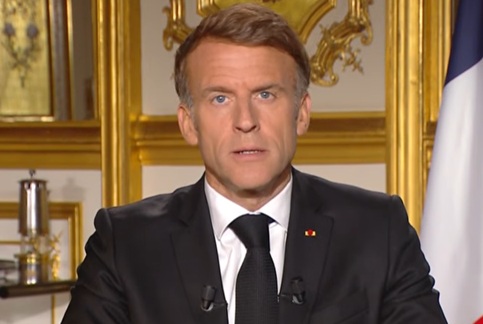
French President Emmanuel Macron / Video Image
In some places the demonstrations have gone chaotic.
But wait…despite the colorful street theater marches, France spends more on education than most other European countries; 5.1 percent of GDP or $100 billion. The Ministry of Education remains a very well-funded but bloated bureaucracy that spends far less on school infrastructure and students than on pensions.
Security observers cite a web of more than 50 communist, Islamist and radical labor union organizations became part of the Oct. 17 uprising; From the French Communist Party (PCF) and a gaggle of groups ranging from the International Communist League, (Trotskyist), New Anticapitalist Party, and ethnic groups such as Palestine Emergency, (French Palestine solidarity).
Principal political movements include far-left socialist political party La France Insoumise (LFI), or France Unbowed as well as the Gilets Jaunes, or “Yellow Vests,” a rural increasingly leftist group that led protests early in the Macron years.
Mid-October demonstrations in Paris were salted with the influence of France Unbowed LFI political Party who is contesting next year’s Presidential elections. Alongside the banners for smaller class sizes were slogans of the French Communist Party (PCF) who though once a mighty force in the country is now integrated into LFI. Slogans “More for Lycées, Less for the Military” proliferated.
And in the restive Parisian suburb of St. Denis who pops up with the local mayor Bally Bagayoko none other than the Swedish demo-troll Greta Thunberg just in time for Halloween!
Yet in these Banlieues, suburbs like St. Denis and others which ring Paris, there’s a powerful Middle-Eastern and West African community of both increasingly radicalized legal and illegal migrants who regularly clash with police and authority. Many troublemakers from the banlieues converged on Paris with the intent of looting and trashing symbols of the French Republic.
On Oct. 17, a lovely Autumn Saturday, a day of mass protest was unleashed as the Lycées students, converged with the revived Yellow Vests Gillet jaunes, and as night fell a fringe of casseurs, the hard-Left and anarchist violent window smashers and looters marched through Paris and cities across France. Contrary to past disturbances the riots were not confined to the banlieues suburbs and the high-profile Champs Elysees, but to parts of Paris where such violence is rare near the Grand Boulevards shopping districts, Les Halles and the tony St. Honore district in central Paris.
The Interior Ministry admitted at least 550,000 joined marches nationwide causing disruption at best and chaos at worst. In Paris the Police, the Gendarmes and the tough anti-riot CRS police contained most trouble; yet in the Place de la Republique, a traditional protest epicenter, urban chaos erupted in pitched battles between protesters and police using water cannon and tear gas. In provincial cities such as Limoges, the historic Town Hall was burned down. There were 2,400 arrests; More than 1,500 businesses, some including luxury stores were trashed.In the southern city of Marseille, observers say there were 30,000 looters over the weekend.
The newspaper Le Journal du Dimanche headlined “France Burns; The Chaos…The assessment, an Apocalyptic day.”
Prime Minister Sebastian Lecornu stated the government would not be “intimidated” by the violence and blamed the unrest on the “ultra-left’.
Melenchon, the Marxist LFI leader has oft described chaos as an expression of “legitimate defense.”
During a somber but stern address to the Nation, President Macron conceded the “anger and the shame” of the nationwide rioting but offered dialogue, yet distinguishing between protesters and looters; “Yes to dialogue, No to violence.”
Still the weekly Le Point shows Macron’s once soaring popularity falling to 17 percent with an astounding 67 percent negative.
Some may argue that protest is in the DNA of many French; yes, but to a point. Many wish to recall or relive the May 1968 massive student demonstrations and riots which finally toppled President Charles de Gaulle. There’s this cherished memory among leftists of a certain age that the young will achieve the same against Macron.
But there’s another variable; a very different France beset by mass uncontrolled immigration from the Third World.
So what’s this all about beyond Les Lyceens?
Profligate government spending has turned into a massive Debt crisis, among the worst for developed countries; France after all is the worlds’ 7th largest economy. Macron has tried to trim costs but is blocked by the fractured National Assembly. Debt has soared to record sums while unemployment holds stubbornly at 8.3 percent, double the American number.
But the forces of chaos and disorder are looking to the Spring 2027 Presidential election where the rightist Marine Le Pen of the National Rally (RN) is favored over the hard-Left Jean-Luc Melenchon’s France Unbowed party (LFI). The current chaos is seen as a rehearsal for major disorders should Le Pen’s party win.
France’s spillover to chaos which willfully disrupts and destroys, shadows the sunup to a tumultuous Spring.
John J. Metzler is a United Nations correspondent covering diplomatic and defense issues. He is the author of Divided Dynamism the Diplomacy of Separated Nations: Germany, Korea, China (2014). [See pre-2011 Archives]
