


Geostrategy-Direct
By Richard Fisher
On Feb. 5, 2026, the 2010 United States-Russia New Strategic Arms Reduction Treaty (New START), negotiated between former President Barack Obama and Russian leader Vladimir Putin expired.
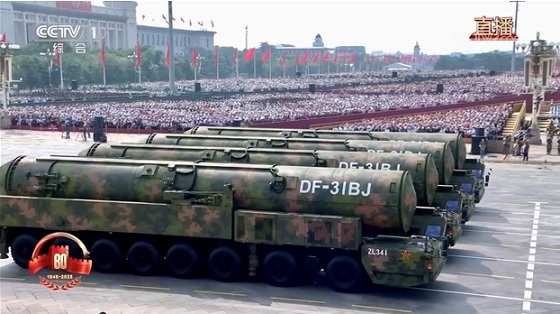
The Trump Administration has made clear that this had to happen in large part due to the actions of the People’s Republic of China (PRC).
New START achieved a low-point in the U.S.-Russia nuclear competition, with both sides committing to deploy only about 1,500 nuclear warheads on intercontinental ballistic missiles (ICBMs) and submarine launched ballistic missiles (SLBMs).
To be sure, New START had suffered many blows from Russia, which halted it implementation of New START on Feb. 21, 2023, but on Feb. 6 U.S. Secretary of State Marco Rubio also made clear that New START no longer protected the United States from China’s growing nuclear threat, saying:
“China’s rapid and opaque expansion of its nuclear arsenal since New START entered into force has rendered past models of arms control, based upon bilateral agreements between the United States and Russia, obsolete. Since 2020, China has increased its nuclear weapons stockpile from the low 200s to more than 600 and is on pace to have more than 1,000 warheads by 2030. An arms control arrangement that does not account for China’s build-up, which Russia is supporting, will undoubtedly leave the United States and our allies less safe.”Then in a Feb. 6 speech in Geneva before the United Nations Conference on Disarmament, Thomas G. DiNanno, Under Secretary of State for Arms Control and International Security, stated, “New START does not allow the United States to credibly uphold both our strategic deterrence commitments to the American people and our extended deterrence commitments to our allies.”
Regarding China’s nuclear force buildup, DiNanno stated, “This buildup is opaque and unconstrained by any arms control limitations.”
DiNanno said of the Chinese strategic force:
“This is the crux of the problem. It is emblematic of the change in the global strategic environment over the last 15 years.”China supports Russia’s brutal war against Ukraine with purchases of Russian petroleum and other resources that in 2025 alone were worth and estimated $100 to $130 billion, while selling Russia about 80 percent of sanctioned components for drones and other Russian weapons used to attack Ukraine.
Russia, meanwhile, is assisting China’s buildup of nuclear weapons; It sold China an initial 6.5 tons of Highly Enriched Uranium (HEU) by 2023 for China’s initial CHF-600 fast breeder reactor on Changbiao Island in Southern China, which is estimated to produce enough weapons grade plutonium to support the construction of 50 nuclear weapons.
In 2026 China is expected to have two CHF-600 fast breeder reactors in operations and is building two more, that will benefit from an additional 25 tons of Russian “specialized fuels,” meaning they will be producing enough plutonium annually to enable a large number of new People’s Liberation Army (PLA) nuclear warheads.
These four CHF-600 fast breeder reactors, plus about 58 Chinese reactors and existing nuclear fuel reprocessing facilities, are expected to be able to produce enough weapons grade fuels to produce, according to the U.S. Intelligence Community, 1,000 PLA nuclear warheads by 2030, and 1,500 nuclear warheads by 2035.
Full Text . . . . Current Edition . . . . Subscription Information
Free Press International
