


Special to WorldTribune, August 18, 2026 Real World News
Geostrategy-Direct, August 11, 2026
Gulf states which rely on shipping in the Strain of Hormuz to import food and other household necessities are having to find alternative, long-term overland logistics which are driving up inflation.
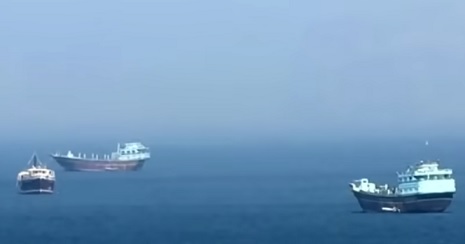
Vessels sail in the Perisan Gulf near the Strait of Hormuz. / Video Image
For five months the narrow stretch of water at the mouth of the Persian Gulf between Iran and Oman has been in a state of paralysis.
“A lot of the necessities, and I’m talking food, that these Gulf nations require — Kuwait, the UAE, Bahrain, Qatar, Saudi Arabia — comes in by boat,” said Shon Hiatt, an associate professor of business administration at the University of Southern California’s Marshall School of Business and director of its Zage Business of Energy Initiative.
“So, what have they been doing? They’ve been flying in, whenever they can, their food products and their household goods. And that’s caused inflation in these states.”
Shipping companies such as Maersk added an emergency surcharge on cargo going to or from the UAE, Qatar, Saudi Arabia, Bahrain, Kuwait, Iraq, and Oman in the first weeks of the conflict. Other carriers soon followed.
Shipping traffic through the Strait of Hormuz fell to less than 10 vessels per day amid fading hopes of a peace deal between the U.S. and Iran.
Four commodity vessels, including two empty oil product tankers, entered the waterway, data from Kpler showed on Aug. 4. Two vessels — a small tanker laden with liquefied petroleum gas and another carrying residual fuels — exited the Strait, the data showed.
In pre-war days, about 130 to 140 ships typically transited the strait each day.
Writing for The Media Line on Aug. 10, Jacob Wirtschafter noted: “Planes have helped move high-value cargo, but air freight only makes sense for small, expensive, urgent cargo such as medicine and electronics. It cannot move grain or building materials at the volumes a country needs.”
The Abu Dhabi National Oil Company said that 16 of its ships had been hit by missiles and drones since the war began, three of them in a single week, killing one crew member and injuring 20.
Qatar lost about 17% of its capacity to export natural gas when Iranian missiles struck the Ras Laffan plant in March, and two cargoes loaded there have been attacked at sea since July.
“Hormuz is the dominant economic channel in our estimates for the wider world economy, mainly Asian importers and Europe,” said Mohamed Shadi, head of energy and logistics at the Al Habtoor Research Center in Dubai.
Shadi told The Media Line that the United States sells more energy abroad than it buys, so the price spike caused little lasting damage there.
Whether ships return when a lane opens will be decided by the companies that own them and the insurers that cover them, not by governments alone.
Asked what he would want if he sat on a tanker company’s board, Hiatt said he would watch the Chinese-flagged ships go first, then a non-Chinese one, then wait a week.
“I’d want to see other ships go through first,” he said.
Meanwhile, President Donald Trump said on Aug. 10 that the United States controls the Strait of Hormuz and had cleared the strategic oil waterway of Iranian mines.
“Look, the only one that has control of the Strait of Hormuz right now is the United States Navy,” Trump told reporters in the Oval Office. “We’ve mine-swept the entire strait.”
Full Report . . . . Current Edition . . . . Subscription Information
