


Analysis by WorldTribune Staff, July 7, 2026 Non-AI Real World News
In a taste of what a Kamala Harris (Obama) Administration would have looked like . . . .
The administration of leftist South Korean President Lee Jae-Myung on Tuesday continued its assault on free speech with the enactment of the Communications Network Act.
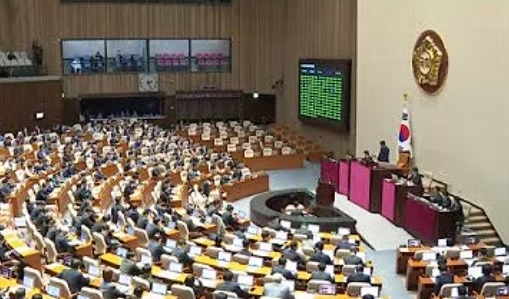
South Korea’s ruling leftists passed the Communications Network Act in December 2025. / Video Image
The so-called “fake news” law, pushed by Lee’s ruling Democratic Party of Korea, defines “false or manipulated” information as content whose whole or partial substance is untrue, or altered in a way that misleads audiences into believing it is factual, The Korea Times reported.
The revised law, passed by the National Assembly on Dec. 24, 2025, designates “large-scale information and communications service providers” based on user numbers and sales, imposing various obligations. It also allows courts to order punitive damages up to five times the amount of harm caused by the intentional or grossly negligent dissemination of false information.
“U.S. lawmakers and industry circles view this as targeting major U.S. tech firms like Google, Meta, and X (formerly Twitter) operating in South Korea, with active lobbying efforts underway,” The Chosun Ilbo reported after the law’s passage.
The law also introduces a new category of illegal hate or discriminatory expression which covers posts that incite violence, discrimination, or hatred against individuals or groups based on traits such as race, nationality or gender.
The law has drawn criticism even from pro-government groups for its vague and arbitrary definitions of “false and illegal information.”
The U.S. State Department said the law “undermines freedom of expression.”
Sarah Rogers, the State Department’s Under Secretary for Public Diplomacy, called the law a “censorship by regulators threatening U.S.-Korea tech cooperation.”
In a written response to an inquiry by The Chosun Ilbo, the State Department stated: “The U.S. expresses serious concern over the South Korean government’s approval of the revised Network Act. This revision negatively impacts U.S.-based online platform businesses and undermines freedom of expression.”
The State Department added: “South Korea should not erect unnecessary barriers to digital services. The U.S. opposes censorship and remains committed to cooperating with South Korea to foster a free and open digital environment for all.”
. . . . But the algorithmic censorship that has suppressed news platforms like WorldTribune.com since the Biden Administration is still in full effect despite the election of Donald Trump in 2024.
🚨🇺🇸🇰🇷 한글 아래 – South Korea’s Censorship Era Begins Today—Dissent Is Now A Crime
South Korea’s Lee regime has officially crushed free speech with its “fake news” law that has kicks in today.
Under the revised Information and Communications Network Act, platforms, YouTubers,… pic.twitter.com/Wlosb63Io8
— Christopher Kostic (@ShineShadowNews) July 6, 2026
The Korea Times, which like other major South Korean media has deferred to the increasingly authoritarian government of Lee Jae-Myung posted a Q & A on the new law:
Q. What should I do if I suffer harm from false or manipulated information?
A. Anyone who encounters information suspected of being false or manipulated can file a report with a large online service provider, including the location of the content, reasons for the complaint, any supporting evidence and contact information for follow-up. Additionally, you may bring a civil claim for compensation and if the poster is a large-scale professional publisher of facts or opinions to the general public, victims may seek enhanced damages.
Q. If a YouTuber with 150,000 subscribers spreads false or manipulated information in their videos, does the account holder fall under the aggravated damages rules?
A. Yes. A YouTuber who has posted at least three videos in the past three months, earns income from those posts and has 100,000 or more subscribers or an average of 100,000 views over that period can be subject to enhanced civil damages if they intentionally distribute illegal false or manipulated information that causes harm.
Q. What steps must online platforms take when they receive a complaint?
A. If a large service provider finds that the reported content violates its own policies, it may delete or block the content or remove the account to prevent further spread. When it is hard to determine the facts, the provider can work with an external fact‑checking body and rely on its decision. Whenever the provider deletes or blocks content or an account, it must notify both the complainant and the poster of the result, explain the reasons and inform the parties that they may file an objection within six months and seek dispute mediation over the decision.
Q. Because the government supports fact-checking bodies through the transparency center, critics say those groups may be susceptible to political pressure. Is that the case?
A. The government provides support through the transparency center. It does not intervene in fact-checkers’ choice of topics, their procedures or the substance of their work.
Q. What should I do if I see hate speech online?
A. Users who encounter suspected hate speech can report it to the relevant online platform or request a review by the KMCC. Reports should include the location, the reason for the complaint, why the content is considered hate speech and any supporting materials. If the KMCC concludes that the content is hate speech, it may demand corrective measures such as deletion or blocking of the material.
Q. What happens if a platform fails to take the required action?
A. If a large online platform does not fulfill its duty to delete or block hate-speech content, the KMCC may issue a corrective order. If the platform refuses to comply without legitimate reason, it can face criminal penalties under the Information and Communications Network Act.
Q. Will political criticism or satire also be regulated as hate speech?
A. No. The revised act is not intended to restrict political criticism, satire or the expression of diverse opinions. It targets only information that directly incites violence or discrimination against specific individuals or groups or foments hatred in a way that gravely undermines human dignity. In deciding whether a post is hate speech, authorities consider not just the words themselves but also the context, how it was created and its social impact, so merely causing offense is not enough for content to be treated as hate speech.
