


Special to WorldTribune, October 2, 2026 Real World News
Geostrategy-Direct, September 29, 2026
Amid ongoing disruptions in the Strait of Hormuz, the Iraq-Syria border has rapidly transformed into a vital regional energy corridor, demonstrating the major shift in regional alignments.
The geopolitical shift occurs exactly as the United States officially finalized the total withdrawal of its military forces from Iraq, concluding a 12-year anti-ISIS campaign while critics said the move leaves Kurdish allies highly vulnerable.
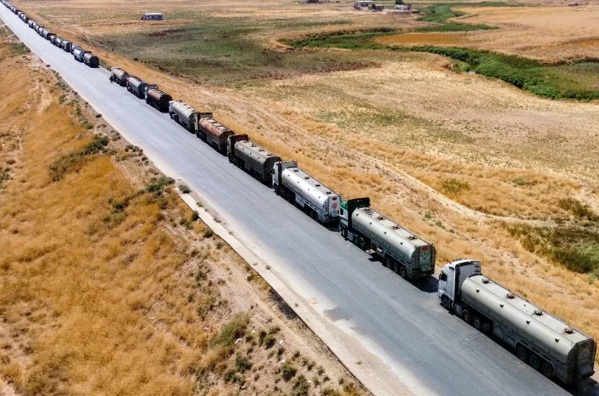
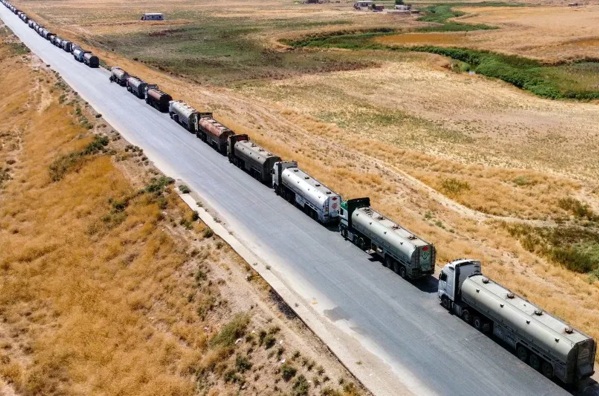
Aerial view shows oil tanker trucks on the M4 highway in Tal Tamr in Syria’s northeastern Hasakeh province on Sept. 16. / Delil Souleiman / AFP via Getty Images
According to regional analyses and reports from state media outlets like SANA, Iraq and Syria are increasingly integrating their energy logistics:
Massive trucking networks: Between 1,000 and 1,200 trucks carrying Iraqi oil cross Syrian territory daily, heading toward international markets via Syrian ports like Baniyas.
Diversified export strategies: Iraqi Prime Minister Ali al-Zaidi recently emphasized at the United Nations General Assembly that Baghdad is actively building energy pipelines and corridors through Syria, Turkey, and Jordan. This strategy explicitly aims to bypass maritime blockades and terror attacks on vessels that frequently spike global energy prices.
Third-party commercial backing: International suppliers and entities — such as Qatar-based UCC — are funding fuel acquisitions while Syrian authorities facilitate domestic land transit in exchange for lucrative transit fees.
As land routes open up, the security landscape has changed dramatically with the departure of the U.S.-led coalition under an agreement between Washington and Baghdad.
On Sept. 30, U.S. Central Command (CENTCOM) confirmed that the final remaining American troops vacated the Erbil Air Base in the semi-autonomous northern Kurdish region, officially closing the book on Operation Inherent Resolve.
Meanwhile, the Kurdish Regional Government’s Peshmerga Ministry voiced profound anxiety regarding the removal of American Patriot and C-RAM air defense systems.
The region has absorbed over 1,000 drone and ballistic missile strikes since early 2026 amid broader regional conflicts involving Iran and its terror proxies, leaving local populations vulnerable against future airborne threats.
With the security vacuum fully open, Iran-aligned militias have celebrated the withdrawal as a triumph for Iraqi sovereignty.
Kurdish military commanders warn that a lack of U.S. intelligence and drone support is already allowing ISIS sleeper cells to mobilize and regroup across northern Iraq and Syria,
“One of the most important developments in the Middle East is taking place along the sun-scorched border between Iraq and Syria,” Seth J. Frantzman noted in a Sept. 28 analysis for The Jerusalem Post.
“Things have been quiet there in recent years. It was not always this way. Back in 2014, the extremist group ISIS [Islamic State] used the long, open border to invade Iraq. Later, Iranian-backed militias, going the other way, moved into Syria’s Euphrates River Valley from Iraq.
“Today this has changed. The border is peaceful. Iraq and Syria once again control the area. The crossing is used for important trade in oil and natural gas. It has become an economic energy corridor. Iraq ships oil via trucks to Syria for export. Syria is sending gasoline to Iraq.”
Full Report . . . . Current Edition . . . . Subscription Information
