


WorldTribune, June 30, 2026 250 Years of Freedom
Commentary by Christopher Flannery
The following is excerpted from an article in Imprimis, a publication of Hillsdale College
John Adams left a legacy of freedom not only with his life but in his death.
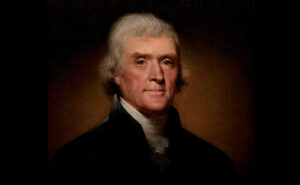
Official Presidential portrait of Thomas Jefferson / Rembrandt Peale, 1800
In 1826, at the age of 90, as one of the surviving signers of the Declaration of Independence and a former president, he received an invitation from the mayor of Washington, D.C., to attend a celebration of the 50th anniversary of American independence. He declined the invitation for reasons of ill health. But on June 30, 1826 — four days before that anniversary — he received in his home in Quincy, Massachusetts, the Reverend George Whitney and representatives of Quincy’s July 4th celebration committee. They asked the great statesman for a toast to be presented in his name on the Fourth of July. Adams proposed, “I will give you, ‘Independence Forever!’” They asked if he would like to add anything, and he replied, “Not a word.”
It was Adams’ last public act. He died on July 4, 1826, fifty years to the day after the adoption of the Declaration of Independence by the Continental Congress.
Thomas Jefferson received the same invitation Adams received to celebrate the 50th anniversary of American independence. The last letter in Jefferson’s handwriting of which we have any record is his response to that invitation, dated June 24, 1826.
Like Adams, Jefferson was too ill to attend. And like Adams, he would die — as if American destiny had decreed it — on the day for which the celebration was scheduled.
In his response, sent from Monticello, Jefferson reflected on the meaning of the Declaration, of which he was the famous author, and he showed that his revolutionary spirit had not dimmed. “May it be to the world,” he wrote:
what I believe it will be, (to some parts sooner, to others later, but finally to all), the Signal of arousing men to burst the chains under which monkish ignorance and superstition had persuaded them to bind themselves, and to assume the blessings and security of self government. . . . All eyes are opened, or opening, to the rights of man. The general spread of the light of science has already laid open to every view the palpable truth that the mass of mankind has not been born with saddles on their backs, nor a favored few booted and spurred, ready to ride them legitimately, by the grace of God. These are grounds of hope for others. ….
John Quincy Adams was President of the United States when he learned that his father and Jefferson had both died on that Fourth of July. He wrote in his diary what many others were thinking and saying, that this was a manifestation of “Divine favor.”
|
May it be to the world what I believe it will be, (to some parts sooner, to others later, but finally to all), the Signal of arousing men to burst the chains under which monkish ignorance and superstition had persuaded them to bind themselves, and to assume the blessings and security of self government. |
Daniel Webster, who was invited to deliver a eulogy in Faneuil Hall in Boston the following month, called the passing of Jefferson and Adams on that day a “dispensation of the Divine Providence.” “Adams and Jefferson are no more,” he intoned, but “their work doth not perish with them.” “No age will come,” said Webster, “in which the American Revolution will appear less than it is, one of the greatest events in human history.”
