


by WorldTribune Staff, September 20, 2026 Non-AI Real World News
The United States must be fully prepared for the potential sudden collapse of a nuclear-armed Chinese Communist Party (CCP), China analyst Miles Yu wrote.
In a Sept. 14 analysis for The Washington Times, Yu laid out why such a collapse is a risk:
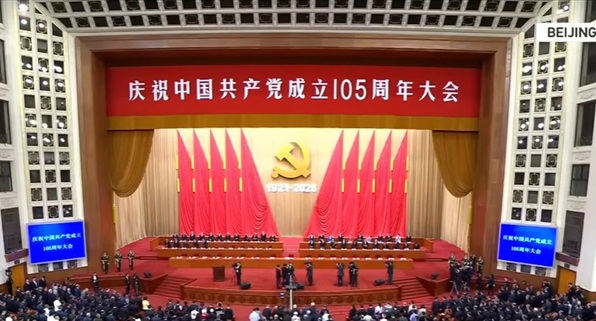
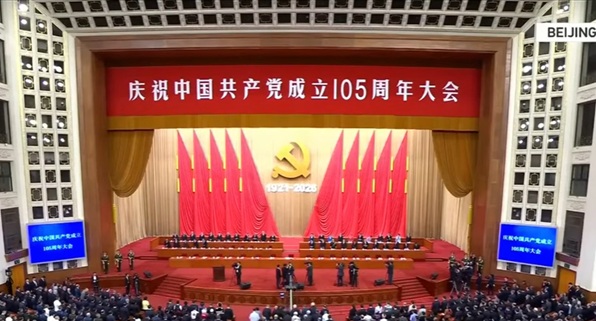
In July, the Chinese Communist Party celebrated the 105th anniversary of its founding. / Video Image
• The CCP controls vast nuclear arsenals.
• Advanced biological laboratories exist across the nation.
• The military is the world’s largest by personnel.
• State enterprises are embedded globally.
• Sudden failure risks major global chaos.
“The greatest strategic challenge posed by China may not be what happens if the Chinese Communist Party succeeds, but what happens if it suddenly fails,” Yu wrote.
While Western policy has focused on China’s military aggression, countering its economic coercion, protecting technology, defending Taiwan and competing with Beijing for global influence, it has failed to direct attention to the possibility of the collapse of communist rule, Yu contended.
“History repeatedly demonstrates that seemingly permanent dictatorships can disappear with astonishing speed. In 1989, six communist governments in Eastern Europe fell within months. The Berlin Wall, perhaps the most imposing physical symbol of the Cold War, fell almost overnight. Two years later, the Soviet Union itself vanished,” Yu noted.
The Hudson Institute report “China after Communism: Preparing for a Post-CCP China” argues that the sudden collapse of the world’s longest-ruling communist dictatorship and second-largest economy is hardly inconceivable.
“The collapse of central authority could therefore create simultaneous military, financial, humanitarian, political and proliferation crises,” Yu noted.
“Who controls the nuclear arsenal? Who commands the People’s Liberation Army? What becomes of the People’s Armed Police, the militia, the Ministry of State Security and the vast domestic surveillance apparatus? Who secures dangerous biological facilities? Who prevents provincial military commanders or security chiefs from becoming warlords? What happens to the renminbi, China’s banks, sovereign obligations, state enterprises, foreign reserves and trillions of dollars of domestic assets?
“Then come the political questions. What happens in Tibet and Xinjiang — ethnic vengeance or immediate declaration of independence? What becomes of Hong Kong? How should a new government deal with Taiwan? What to do with the 100 million CCP members? How should the crimes of the Mao-to-Xi era — Tiananmen, religious persecution, mass surveillance, forced labor and other abuses — be investigated without turning justice into vengeance?”
These questions need to be addressed before a collapse of the CCP, Yu stressed.
“The central lesson of 20th-century regime transitions is that preparation matters.
“Washington should establish a permanent interagency planning mechanism for a post-CCP contingency and begin working quietly with allies, Chinese democrats, economists, constitutional scholars, dissidents, religious leaders, overseas Chinese communities and specialists in transitional justice.
“Readying for China after communism is not a regime-change policy. It is insurance against the most consequential political contingency of the 21st century.”
