


Special to WorldTribune.com
 By John J. Metzler, June 12, 2026
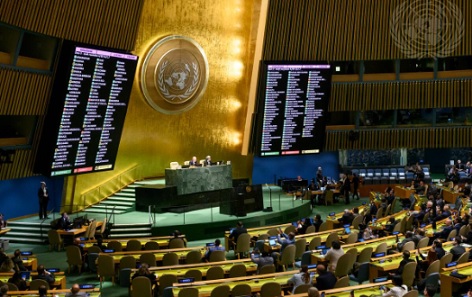
The UN General Assembly has a busy year ahead..
First the members have chosen its new President to preside over the 81st General Assembly. Then the 193 members picked five new non-permanent members to serve on the fifteen-member Security Council. Lastly, later in the year, the full Assembly will choose a new Secretary-General to lead the multinational organization for the next five years.
In early June, the Assembly chose between the former Bangladesh Foreign Minister Khalilur Rahman and the Ambassador of Cyprus, Andreas Kakouris. In a narrow and surprising outcome, Bangladesh won with 99 votes over 91 for Cyprus. Thus, Minister Rahman of the People’s Republic of Bangladesh will replace Germany’s Annalena Baerbock who held the post and skillfully navigated the world body through the UN’s 80th anniversary year.
Later the Assembly elected five new members to serve two-year terms on the powerful Security Council. The candidates came from regional groups and, as is so often the case, were selected in non-competitive elections. Sadly, this shortcoming guarantees mediocrity or worse without any chance of opposition.
Based on regional groupings such as Africa, Asia, Latin America/Caribbean and Western Europe, the annual process however produced more than the usual political surprises.
UN General Assembly
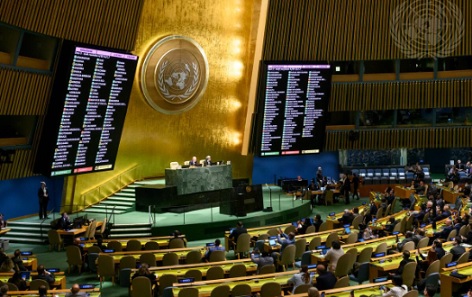
It’s a diplomatic game of musical chairs for a seat at the decision-making Security Council.
Africa. The sole candidate put forward unopposed for the African continent was Zimbabwe, an odious regime once led by Robert Mugabe and still ranking among the lowest in civil and human rights standings.
Asia Pacific. Two countries ran for one seat, Kyrgyzstan and the Philippines. The Philippines was a original member of the UN back in 1945; its diplomats such as Carlos Romulo, were highly respected back in the day. The U.S., Japan and many key East Asian states supported the Philippines, and it was presumed they would win. Kyrgyzstan, a former Soviet republic and a human rights scofflaw, can claim to be the least repressive of five other former Soviet-stans, but this is hardly a qualification.
But when the ballots were counted, Kyrgyzstan won after four rounds of voting, ultimately prevailing by 142 to 49 over the Philippines, and easily clearing the two-thirds majority in the 193-member Assembly. This will be the first time Kyrgyzstan sits on the Security Council since its UN membership in 1992.
This outcome clearly reflects growing geopolitical tensions in Asia as Kyrgyzstan is close to the Russian/Chinese sphere which would counterbalance the Philippines who as an improving democratic state increasingly partners with the United States, Japan and Australia.
Latin America/Caribbean. The island state of Trinidad and Tobago, was selected unopposed with a vote of 181.
Western Europe. Europe’s election was the most closely watched as it pitted three friendly and democratic countries against each other for two seats. Portugal, the country of the long-serving Secretary-General Antonio Guterres, was set to win. Then Austria and Germany competed for the other seat.
Portugal won handily with 134 votes. Surprisingly so did Austria with 131 votes to Germany’s 104.
Germany, which had served six previous Council terms, most recently in 2019–2020, lobbied hard for the post. Germany’s cyclical participation on the Council is a kind of unofficial pro-forma deal as have Japan, India and Brazil. Germany’s government may have assumed the old calculus would win as in the past but the current mood at the UN is nervously unpredictable.
Despite being a major UN contributor and global humanitarian donor, Germany lost. This setback marks the first time that Germany has failed in a bid for a non-permanent seat on the Council.
Some diplomats suggest the result reflects Germany’s NATO membership and a close supporter of Ukraine and Israel. Russia put the whammy on Berlin’s bid over Ukraine without question and one may assume many Arab states used the same logic vis a Germany’s stand on Gaza and Israel. German Foreign Minister Johann Wadephul described the result as “a real disappointment” and a “bitter defeat.”
Austria won handily. Without question Austria is a proud democracy and totally qualified for the post. But recall Austria is legally neutral and thus not a NATO member and let’s say a “bit more nuanced” on its Mid-East policies to say the least.
Austrian Foreign Minister Beate Meinl-Reisinger commented, “Austria is back at the table where decisions on peace, security and stability are made.”
The five countries elected shall replace Denmark, Greece, Pakistan, Panama and Somalia when their terms conclude at the end of 2026.
In the meantime, the Council still faces the decade-plus diplomatic logjam hindering its efficacy.
John J. Metzler is a United Nations correspondent covering diplomatic and defense issues. He is the author of Divided Dynamism the Diplomacy of Separated Nations: Germany, Korea, China (2014). [See pre-2011 Archives]
