


by WorldTribune Staff, September 18, 2026 Non-AI Real World News
President Donald Trump is fed up with “fake news.”
The president on Friday took the unprecedented step of banning CNN, MS Now, and Politico from the White House.
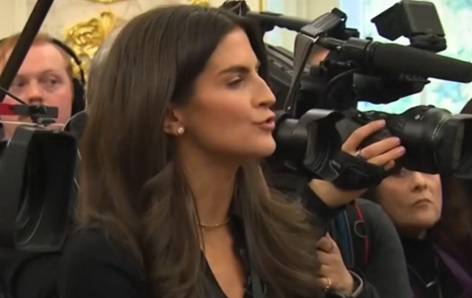
CNN White House corespondent Kaitlan Collins / Video Image
Trump wrote in a post to Truth Social:
“I am proud to announce that, effective immediately, I am banning Fake News CNN, MSNOW (who recently changed their name from MSNBC due to lack of viewership and credibility!), and Politico (The recipients of an illegal and ridiculous $8 Million Dollar subscription, an All Time Record, directly from the United States Government, under Crooked Joe Biden, in order to keep them “alive.” Seems like corruption to me!), from the White House as a result of their constant “reporting” FAKE NEWS!
“Media Outlets shouldn’t be able to constantly write or report FICTION and LIES when they’re covering the President of the United States, the Trump Administration, or the United States of America.
“Other Fake News Media Outlets to follow. Thank you for your attention to this matter! President DONALD J. TRUMP.”
Lawsuits from the media outlets are expected to be filed quickly.
Last year, the Associated Press was banned from certain White House spaces and press pool events after the leftist news organization refused to adopt the renaming of the “Gulf of America.”
The Associated Press filed a lawsuit against the Trump White House and a federal judge previously sided with the AP.
In April 2025, U.S. District Judge Trevor McFadden, a Trump appointee, granted the AP’s injunction against the White House and lifted the block as the lawsuit makes its way through the courts.
Judge McFadden clarified that the government can choose which journalists to participate in specific interviews.
The D.C. Circuit Court of Appeals ruled 2–1 to pause the lower-court’s injunction, allowing the White House to continue barring The Associated Press from restricted spaces like the Oval Office and Air Force One while the litigation proceeds.
The full D.C. Circuit later declined to rehear or overturn the panel’s decision to keep the restrictions in place while the broader legal challenge continues.
The ruling applies to restricted and smaller presidential spaces, leaving separate lower-court provisions concerning larger venues like the East Room partially distinct.
