


Special to WorldTribune.com
 By John J. Metzler, September 20, 2026
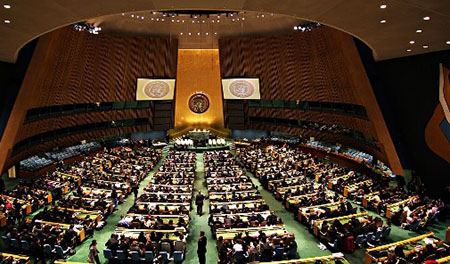
Presidents, Prime Ministers, Kings and potentates are convening in New York for the annual General Assembly of the United Nations.
The upcoming 81st Assembly not only brings together its 193 member states to discuss and debate global conflict, but hopefully to try to resolve political and humanitarian crises challenging what has become a decade of widening chaos, refugees and resource shortfalls.
Traditionally the General Debate speeches in the cavernous Assembly hall begin with the presidents of Brazil and the United States; That starts on Tuesday Sept. 22 and lasts for a full week on what soon seems like endless palaver. So, following Brazil’s Lula and U.S. President Donald Trump comes the King Abdullah II of Jordan, Presidents Erdogan of Turkey, Macron of France and Lee Jae Myung of South Korea.
But beyond the formal speeches, it’s on the Assembly sidelines and in unofficial meetings and “bilaterals” where amazing combinations of delegates and interest groups present their cases before groups like the African Union, the Arab League, European Union, etc.
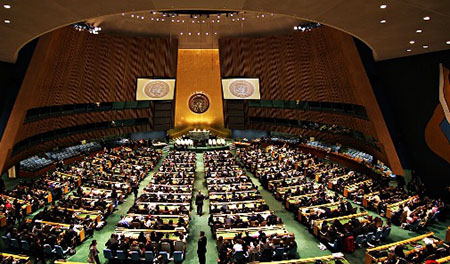
UN General Assembly
Khalilur Rahman, a former Foreign Minister of Bangladesh became the newly elected President of the 81st Assembly. During his inaugural address he told assembled delegates, “We must make the United Nations fit for the future,…We have a situation where trust is in deficit.” He intoned, “This is not 1945. This is the 81st session. The world has moved on. The Organization must move on.”
Assembly President Rahman outlined a key theme for the year: Restoring trust, managing transformation.
Naturally the new Assembly session faces multifaceted crises among them Russia’s war in Ukraine, the U.S./Israeli conflict with Islamic Iran, chaos in Gaza, and the latest flashpoint in Yemen. Combine this with the endless Palestinian and Gaza debate in all its creative permutations, massive humanitarian crises and refugee displacements in places ranging from Sudan, South Sudan, Ukraine, and Yemen and you begin to see the picture.
Look at a few staggering numbers; Out of Sudan’s population of 47 million, 34 million need humanitarian aid. Of Yemen’s population of 35 million, 22 million need aid. Syria where the guns have finally fallen silent, from a population of 25 million, 15 million still require humanitarian assistance.
We are not just talking about military conflict but the dire downstream effects of refugees, dislocation and unintended impacts on food and fuel supplies. The Ukraine war has dangerously impacted grain supplies being shipped through the Black Sea from both Ukraine and Russia.
The powerful fifteen-member Security Council, tasked to maintain international peace and security, has faced deadlock for over a decade as permanent veto holding five face off on crucial issues; U.S./UK/France vs Russia and the People’s Republic of China.
Then there’s the lingering and still complex issue of Artificial Intelligence; The perpetual AI
Genie which is out of the bottle, but nobody really knows the parameters or the consequences.
Secretary General Election
Yet beyond the perennial issues of War and Peace and global humanitarian development the UN has a uphill challenge this Autumn; Selecting a new Secretary General to lead the global organization starting in January 2027.
For two terms over the past decade Antonio Guterres of Portugal has led the UN; His second term was tempestuous and controversial. Russia’s war in Ukraine strained the organization both in political credibility and humanitarian mettle as did the aftermath of the October 7th terrorist attacks on Israel which deepened divides.
Selecting a new Secretary General from Latin America, and preferably a woman, is the unofficial mandate. There are currently eight candidates.
Major Conflicts
Islamic Iran, the Strait of Hormuz, Yemen, Gaza, Ukraine are all on the sharp end of crises. The return of the Houthis, the Iranian-backed proxy in beleaguered Yemen is a case and point. The Houthi terrorists challenge merchant shipping in the strategic waters of the Bab al-Mandeb Strait maritime chokepoint connecting the Red Sea with the Gulf of Aden and the wider Indian Ocean. The new Houthi flareup targeting Saudi oil shipments has re-ignited.
Secretary General Guterres in a press conference warned, “At this critical moment in the Middle East, de-escalation must be priority one, priority two and priority three.”
Maritime conflict, ranging from the Straits of Hormuz which carries 20 percent of global petroleum supplies, Yemen’s Bab al-Mandeb a crucial oil conduit, and the Black Sea grain passage go beyond the military dimension. They control fuel and food supplies creating both scarcity and higher costs on a global scale and widening humanitarian challenges.
Significantly, supporting freedom of navigation thus emerges as a core principle for the United States and its partners. Solving these crises would begin to rebalance the world.
John J. Metzler is a United Nations correspondent covering diplomatic and defense issues. He is the author of Divided Dynamism the Diplomacy of Separated Nations: Germany, Korea, China (2014). [See pre-2011 Archives]
Support Free Press Foundation
