


Special to WorldTribune.com
 By John J. Metzler, September 28, 2026
The global winds of war, chaos, and political polarization have swept into the vast UN General Assembly Hall, swirling through a seemingly endless speakers list of 193 member states.
Though the 81st Session largely lacked the open political rancor of some past Assemblies, the just ended annual “General Debate” of world leaders and potentates illustrates both promise and peril on how and whether key global conflicts can be solved or shelved for future generations.
Sec. Gen. Antonio Guterres set the somber tone in a stark and challenging opening address to assembled world leaders, “The fault-lines in our world are widening. Cracks have become canyons.… Geopolitical divides have deepened.”
Here’s a quick review of some of the key speeches.
United States
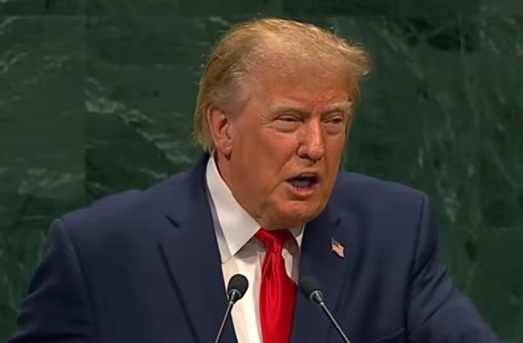
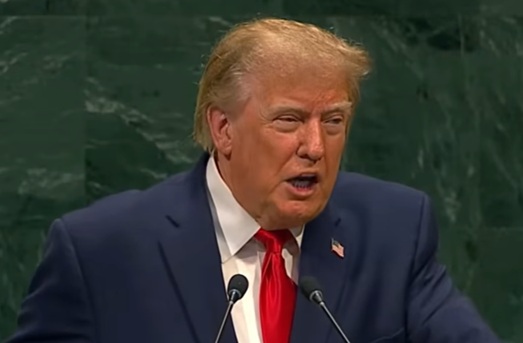
U.S. President Donald Trump addresses the 81st Session of the UN General Assembly. / Video Image
All attention focused on President Donald Trump as he addressed the Assembly with a wide-ranging speech focusing on America’s economic re-bound, the 250th anniversary of American independence, and the key crises which continue to shadow the global agenda.
Viewing the seemingly never-ending security standoff with the Islamic Republic of Iran over that regime’s incessant pursuit of nuclear weapons he postured; “But I have a big decision to make. Will a deal be made with Iran that lets them rebuild and create a far greater country than it ever was before? Or do I annihilate the Islamic Republic and do it quickly, never giving them a chance to kill and destroy people and countries again?”
President Trump assured delegates, “Iran will never have a nuclear weapon.” The Trump speech was generally well received and marked yet another line in the sand for the Teheran regime.
Israel
Israel’s Prime Minister Benjamin Netanyahu, in a stirring address to the Assembly again focused on the Iranian nuclear threat; “Fourteen years ago, I stood on this podium, and I drew a red line. I vowed to prevent Iran’s murderous dictatorship from developing atomic bombs, nuclear weapons aimed at destroying Israel, nuclear weapons that could threaten the entire world. That’s exactly what we did.”
The Israeli speech was marred by diplomats from dozens of delegations leaving the Hall before Netanyahu spoke. I have never personally witnessed such a large and shameful spectacle in the Assembly in my decades of coverage. Up to 77 countries from the 193 member states walked out or left their seats empty. Outside the UN gates in New York City, loud demonstrations by Gaza activists and Palestine groupies, egged on by NYC Democrat Socialist Mayor Zohran Kwame Mamdani created a boisterous spectacle.
Yet Benjamin Netanyahu was unfazed. He stated, “Devastating Iran’s nuclear facilities was hard. It was very hard to do. But for me, it was one of the easiest decisions I’ve ever had to make as prime minister. Because if we hadn’t done it, we’d all be dead.” He quipped ironically, “In defending itself, Israel is also defending many of the countries whose delegates just left this hall!” He equally rebuffed genocide allegations.
Since the October 7, 2023 Hamas attacks on Israel, the Israel Defense Forces (IDF) have counterattacked; For three years, they have been ceaselessly fighting a seven-front war. “Seven fronts: Hamas, Hizbullah, the Houthis, Iran, militias in Iraq, militias in Syria, Palestinian terrorists in Judea/Samaria. They all ganged up on us to wipe us off the face of the Earth. They failed,” Netanyahu boasted.
His most memorable statement echoed his late brother Yoni, a paratroop officer on the eve of the June 1967 Six Day war. The young “Bibi” Netanyahu asked his older brother what was going to happen? “We’re going to win,” Yoni said. “We have no other choice.” “I remember those words as if it was yesterday. We’re going to win. We have no other choice.” That sentiment was woven through this poignant address.
Ukraine
Volodymyr Zelensky returned to the UN to make another impassioned address to war-weary delegates. “For almost five years now, Russian generals have been trying to carry out Putin’s crazy order to seize our eastern land, the Donetsk region. And just this year, from January through August, the Russian army lost 248,964 people on the battlefield in Ukraine.”
Russia is suffering from targeted Ukrainian drone attacks on its energy sector, especially diesel.
“Ukrainians did not choose this war. We chose not to die. Not to lose our country, our families. Not to lose our independence, our freedom.
We are defending ourselves,” he stressed.
Continuing Zelensky stated, “Ukrainians understand that this winter could be very harsh for us. But in response, we will have no choice but to make it painful for Russia too. And that’s exactly why we say that de-escalation steps are important, are needed before winter. Now.”
In the meantime, the biggest land war in Europe since WWII continues.
John J. Metzler is a United Nations correspondent covering diplomatic and defense issues. He is the author of Divided Dynamism the Diplomacy of Separated Nations: Germany, Korea, China (2014). [See pre-2011 Archives]
