by WorldTribune Staff, May 4, 2026 Non-AI Real World News
The free speech of those advocating in South Korea for the human rights of North Korean defectors is being suppressed by the leftist regime of South Korean President Lee Jae-Myung, according to recent U.S. congressional testimony.
“There are more and more restrictions on freedom in the Republic of Korea — restrictions on freedom of speech, freedom of religion, and other freedoms,” Ms. O told the commission. Increasingly, “the measures to suppress freedom are being codified into laws, and now they are even trying to change the constitution,” Tara O, former American air force intelligence officer and a member of the academic council of the Victims of Communism Memorial Foundation, said at a
congressional hearing conducted by the Tom Lantos Human Rights Commission on rights in both North and South Korea.
[caption id="attachment_155298" align="alignleft" width="452"]
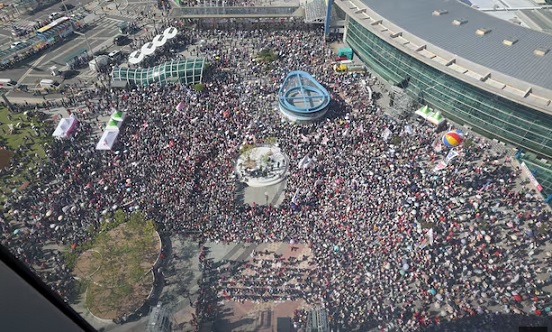
This massive rally against the government of leftist President Lee Jae-Myung held in Daegu was widely unreported by South Korean media. / Kim Dong-Hwan photo[/caption]
The testimony "reflected the widespread impression that the left-leaning president, Lee Jae-Myung, who took over in a snap election a year ago after the impeachment, ouster, and jailing of his conservative predecessor, Yoon Suk-Yeol, has infringed on the rights of individuals who oppose concessions or dialogue with North Korea," Donald Kirk noted in a
May 4 analysis for The New York Sun.
“And who are the people so focused on eroding freedom in South Korea?” Tara O asked, rhetorically. “They are pro-Chinese Communist Party (CCP), pro-Korean Workers’ Party (in North Korea), anti-ROK, anti-U.S. and anti-Japan. They now control the majority of the levers of power in South Korea.”
Related: Analyst testifies that ‘anti-freedom’ Left in South Korea now controls media, ‘levers of power’, April 29, 2026
New Jersey Republican Rep. Chris Smith, co-chairman of the Lantos Commission, named for the late congressman Tom Lantos, a Hungarian who survived the Holocaust and founded the congressional human rights caucus, accused Lee’s government of taking “steps that have had the effect of constraining human rights advocacy related to North Korea.” Among them, he said, were “halting government-sponsored broadcasts into North Korea” and “supporting legislation that allows police to block activists from sending information such as leaflets and digital media into North Korea.”
Such actions, Smith said, “directly affect the ability of civil society – especially defector-led organizations to carry out one of the most effective forms of engagement within the North Korean people: the transmission of information.”
In Seoul, although "Koreans repeatedly say that the South Korean regime is probably less willing to confront North Korea on human rights than at any time in recent years," South Korean media "rarely report on the issue while refraining from direct criticism of Lee and members of his government," Kirk noted.
"These days, defectors and their advocates have almost as much trouble being heard in South Korea as in North Korea," Kirk continued. "Conservative newspapers that once criticized ruling officials and their policies are afraid to speak up while the government pleads for dialogue with North Korea’s leader, Kim Jong-Un."
Tara O said at the hearing: “To help understand the scope of the problem, it’s useful to point out that the major media in South Korea do not report in the news on massive rallies where people call for defending South Korea or a strong alliance with the U.S.”
”Thus, people share these events through social media, and the social media — YouTube (Google Korea), X Korea, Facebook, Threads, etc. are then subsequently censored, as if copying censorship practices” of the People’s Republic of China, she added.
2026 Contract With Our Readers


